
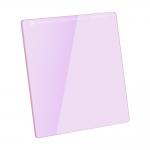
100*100mm Natual Night Square Filter Light Pollution Filter for Night /Sky/Star/Astrophotography Waterproof & Oil Resistant Nano Coating
SKU: KF01.1144
A
With my Fuji with the 10-24 I have small field of view restrictions at 10-15.
A
49mm to 82mm. The largest adapter ring is an 82 to 82 mm, into which you can also screw an 82 mm polarizing filter, as with all other sizes. The outer diameter of all adapter rings is of course even larger.
A
This is possible if you don't have a suitable adapter ring. However, when reducing larger lens diameters, caution is required because of possible vignetting.
A
So with my sigma 10 20, only a little with 11 mm but no longer visible with 12 mm (aps-c)
A
That depends on the lens diameter. This is usually indicated on the lens. The filter holder is then attached to the lens with the appropriate adapter ring
A
The size of the adapter ring depends on the size of the filter thread of the lens used. This is noted on the lens and in the lens cap.
A
it fits in a 100 mm square filter mount, so it depends on the size of the mount adapter to the lens
A
not 100% sure, but the filters of different brands usually have the same thickness, just minor difference, which could be ignored.
A
All gradient filters, whether made of glass or plastic, are coated filters. As far as I know, there are no gradients in the glass. Is due to the production of glass. Nevertheless, there are good to very good results with the glass filters. Lee filters are usually made of plastic, with the ordinal number CR39, from which glasses are also made. They are also coated. In fact, they are very good. Due to this complex production, the filters cost a lot of money. And at Lee Filters they are not cheap especially, although they are made out of "plastic", except for the IR filters. They're made of glass.
A
The od size is 100mm, the set comes with multiple different sizes to fit many different lens. You do not need long exposures for good moon detail, 500 sec at f8 works good on full moon