
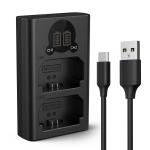
Works without any problems and is also super small & light. With the charger, you can also charge the batteries via a power bank, which is a really great option for traveling!
23/04/2026
Great, it does its job.
Who knows what it cost Sony to put a product like this inside the A7iv, instead of buying it later from third parties
Who knows what it cost Sony to put a product like this inside the A7iv, instead of buying it later from third parties
09/04/2026
I use NP-FZ100 batteries on multiple bodies and having no real chargers started to be limiting, especially when two batteries are almost empty together. Here the idea was simple: a compact charger to always leave in your bag, powered by a bit of everything (power bank, USB hub, wall socket), with the convenience of a double slot.
The charger is very light, but it doesn't give the impression of being empty or fragile. The shell is made of hard plastic, the assembly is clean and the battery housings are well shaped: the hooks “click” clearly and there is no annoying side play. The NP-FZ100 enter without forcing, they remain firmly in place even if the charger is moved during use. I tried it with both an original Sony battery and a compatible one, and in both cases the charge started immediately and ended without anomalies: this gives me a certain sense of security.
The LCD screen shows the status of each battery separately, with a four-segment scale. It is not a 'laboratory' measure, but to understand at a glance if you are at 25, 50 or 75% it is more than fine. All in all, readability is good even in very bright environments, because the contrast is sufficiently marked, even if I would have preferred a more uniform backlight on the edges.
On the connection front, there is both the micro-USB input and the USB-C port. Only the USB-C cable is supplied, so those expecting even the micro-USB cable may be a bit shocked. In practice, the useful thing is that you can connect it to practically any source: smartphone charger, desk power strip, power bank while on the go. The current is managed separately for the two slots, so there is no need to charge one battery at a time.
During charging, the charger heats up moderately, nothing to suggest excessive thermal stress. The batteries come out as soon as lukewarm, as expected with a normal charging current. The declared protections (overload, short circuit, overcurrent, etc.) are not something that you can “see” directly, but the behavior so far has been regular and linear; I only have a small doubt about how accurate the percentage shown is in the last stretch of charge, because the last notch stays on long enough.
Overall, I see it as a charger for everyday use, to be combined without problems with the original one, especially if you manage multiple batteries and want a flexible solution to be used outside the home, without too many complications.
The charger is very light, but it doesn't give the impression of being empty or fragile. The shell is made of hard plastic, the assembly is clean and the battery housings are well shaped: the hooks “click” clearly and there is no annoying side play. The NP-FZ100 enter without forcing, they remain firmly in place even if the charger is moved during use. I tried it with both an original Sony battery and a compatible one, and in both cases the charge started immediately and ended without anomalies: this gives me a certain sense of security.
The LCD screen shows the status of each battery separately, with a four-segment scale. It is not a 'laboratory' measure, but to understand at a glance if you are at 25, 50 or 75% it is more than fine. All in all, readability is good even in very bright environments, because the contrast is sufficiently marked, even if I would have preferred a more uniform backlight on the edges.
On the connection front, there is both the micro-USB input and the USB-C port. Only the USB-C cable is supplied, so those expecting even the micro-USB cable may be a bit shocked. In practice, the useful thing is that you can connect it to practically any source: smartphone charger, desk power strip, power bank while on the go. The current is managed separately for the two slots, so there is no need to charge one battery at a time.
During charging, the charger heats up moderately, nothing to suggest excessive thermal stress. The batteries come out as soon as lukewarm, as expected with a normal charging current. The declared protections (overload, short circuit, overcurrent, etc.) are not something that you can “see” directly, but the behavior so far has been regular and linear; I only have a small doubt about how accurate the percentage shown is in the last stretch of charge, because the last notch stays on long enough.
Overall, I see it as a charger for everyday use, to be combined without problems with the original one, especially if you manage multiple batteries and want a flexible solution to be used outside the home, without too many complications.
04/04/2026
It works perfectly. You can have your spare batteries charged, regardless of the camera.
Perfect for leaving them charging at the hotel or anywhere, while you're still using the camera.
Perfect for leaving them charging at the hotel or anywhere, while you're still using the camera.
02/04/2026