
Reviews
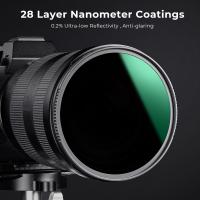
Flexible use of an ND or gray filter from 2 to 400
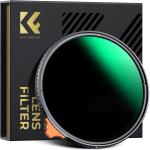
Visually, the item makes a very high-quality impression in its elegant packaging.
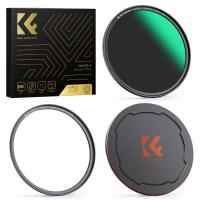
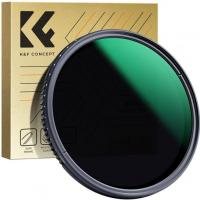
Simply put, you get two polarizing filters (PL) that can be rotated against each other, creating different and flexibly adjustable neutral density filters. These can be continuously adjusted from ND-2 to ND-400. A sturdy lever is attached to the side of the filter, allowing you to rotate the front part.
The rear part fits easily onto a camera filter thread without jamming, provided the environment is suitable. In dusty or sandy conditions, you need to be careful, as with any screw-in filter.
The price for a 77mm diameter filter is just under €100 without a discount. That's quite steep for a screw-in filter without a magnetic system. However, you only need to screw on one filter, and the darkening effect can be continuously adjusted, as mentioned, from ND-4 to ND-400. That's not a lot, but it's usually sufficient in practice.
Many camera systems max out at a shutter speed of 1/8000. However, if you want to achieve a shallow depth of field (smallest aperture/wide open) on a very bright sunny day and/or photograph flowing water, then neither the lowest possible ISO nor a short exposure time will help, because you want to achieve the opposite. This is where neutral density (ND) filters come into play, which are designed to darken the incoming light.
With this ND filter—as with all others that use this technology—two polarizing filters are simply rotated against each other. This reduces the amount of incoming light.
One thing to keep in mind with polarizing filters is that they also eliminate reflections from surfaces. This can be desirable, but also potentially undesirable.
Therefore, you need to carefully consider when using these flexible ND filters is worthwhile and when it's better to rely on conventional, simple ND filters. I would generally recommend magnetic filters here.
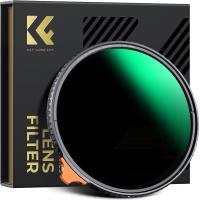
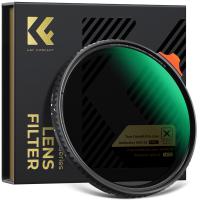
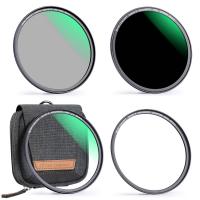
What I really like about the K&F Concept filter is the high-quality packaging and filter case. A small cord on the side makes it incredibly easy to remove the filter attachment from the small leather case.
Conclusion: Pricey but good
I initially gave it four stars, but then decided on five, as I didn't notice anything truly bothersome apart from the price.
That is, if you disregard a few minor things that can be used creatively, such as the blue tint to the light reflections when the filter is rotated beyond the N400 mark.
You wouldn't consider that a flaw in an anamorphic lens; it's simply part of the technology in some cases.
If you found this review helpful, please give it a like!
Simply put, you get two polarizing filters (PL) that can be rotated against each other, creating different and flexibly adjustable neutral density filters. These can be continuously adjusted from ND-2 to ND-400. A sturdy lever is attached to the side of the filter, allowing you to rotate the front part.
The rear part fits easily onto a camera filter thread without jamming, provided the environment is suitable. In dusty or sandy conditions, you need to be careful, as with any screw-in filter.
The price for a 77mm diameter filter is just under €100 without a discount. That's quite steep for a screw-in filter without a magnetic system. However, you only need to screw on one filter, and the darkening effect can be continuously adjusted, as mentioned, from ND-4 to ND-400. That's not a lot, but it's usually sufficient in practice.
Many camera systems max out at a shutter speed of 1/8000. However, if you want to achieve a shallow depth of field (smallest aperture/wide open) on a very bright sunny day and/or photograph flowing water, then neither the lowest possible ISO nor a short exposure time will help, because you want to achieve the opposite. This is where neutral density (ND) filters come into play, which are designed to darken the incoming light.
With this ND filter—as with all others that use this technology—two polarizing filters are simply rotated against each other. This reduces the amount of incoming light.
One thing to keep in mind with polarizing filters is that they also eliminate reflections from surfaces. This can be desirable, but also potentially undesirable.
Therefore, you need to carefully consider when using these flexible ND filters is worthwhile and when it's better to rely on conventional, simple ND filters. I would generally recommend magnetic filters here.
What I really like about the K&F Concept filter is the high-quality packaging and filter case. A small cord on the side makes it incredibly easy to remove the filter attachment from the small leather case.
Conclusion: Pricey but good
I initially gave it four stars, but then decided on five, as I didn't notice anything truly bothersome apart from the price.
That is, if you disregard a few minor things that can be used creatively, such as the blue tint to the light reflections when the filter is rotated beyond the N400 mark.
You wouldn't consider that a flaw in an anamorphic lens; it's simply part of the technology in some cases.
If you found this review helpful, please give it a like!
20/11/2025
Related products
NEW
Arrival
NEW
Arrival
NEW
Arrival
NEW
Arrival
NEW
Arrival
NEW
Arrival
NEW
Arrival
NEW
Arrival
NEW
Arrival
Products You May Like
NEW
Arrival

$135.99 $74.99
Related articles




Blog You May Like




Related Scenes
Best Nd Filter System
Best Nd Filter For Photography
Best Magnetic Nd Filter System
Best Neutral Density Filter For Video
Best Neutral Density Filter For Landscape Photography
Best Lens Filter System
Best Lens Filter For Landscape
Best Filter For Camera Lens Protection
Best Uv Filter For Camera Lens
Best Polarizer Filter For Camera Lens