
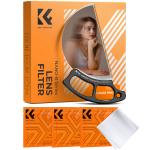
100mm Handheld Motion Blur Filter Optical Glass Prism Special Effect Camera Lens Filter Nano-Basic Series
SKU: KF01.2709V1
This linear prism filter stands out for its high-quality materials and the ability to achieve original visual effects directly during shooting, without the need for post-production. It doesn't screw onto the lens, but is held manually in front of the lens, gripping it with your fingers. This allows you to rotate and move it freely based on the light and framing, offering plenty of scope for creative experimentation.
The system is simple and straightforward, but requires some care: the glass is thick but very delicate, so a single impact or fall can compromise its integrity. Made of optical glass free of visible imperfections, the prism creates an interesting effect that adapts to a variety of visual contexts—both photographic and video—as long as you have a basic familiarity with light and know how to exploit its potential. It's ideal for portraits, music videos, wedding films, or even dynamic shots, where the "trail" effect can add a dreamlike, cinematic feel to the scene.
The included case is very convenient, with a transparent rear compartment designed to store cleaning cloths separately (three are included in the package). This is a practical detail, especially for those who frequently work outdoors and need to keep the lens clean throughout the day.
✅ Pros
• Well-finished optical glass
• Instant creative effects for photos and videos
• Hard case with included cloth holder
❌ Cons
• Must be held by hand; it does not attach to the lens
• Fragile product; handle with care
The system is simple and straightforward, but requires some care: the glass is thick but very delicate, so a single impact or fall can compromise its integrity. Made of optical glass free of visible imperfections, the prism creates an interesting effect that adapts to a variety of visual contexts—both photographic and video—as long as you have a basic familiarity with light and know how to exploit its potential. It's ideal for portraits, music videos, wedding films, or even dynamic shots, where the "trail" effect can add a dreamlike, cinematic feel to the scene.
The included case is very convenient, with a transparent rear compartment designed to store cleaning cloths separately (three are included in the package). This is a practical detail, especially for those who frequently work outdoors and need to keep the lens clean throughout the day.
✅ Pros
• Well-finished optical glass
• Instant creative effects for photos and videos
• Hard case with included cloth holder
❌ Cons
• Must be held by hand; it does not attach to the lens
• Fragile product; handle with care
24/02/2026
This K&F filter seemed like a strange gadget when I ordered it, but wow, the effects I get with it are out of this world! It's like having a special effects generator in the palm of your hand that transforms your ordinary photos into something that looks like it's straight out of a science fiction movie.
I mounted it on my camera to try it out, but without really knowing what I was going to do with it, because it's clearly not your average filter, so we went a bit on a photographic adventure. And the first thing I learned was that the learning curve requires the patience of Job. During my first sessions, I lost several good shots because I didn't have good control over the timing of the effect, especially when photographing scenes with movement. However, once you master the basic technique, you get a very expressive tool. I've started carrying it in my bag all the time because you never know when a lighting situation will lend itself to experimenting. I've discovered that it works especially well during the golden hour, when the warm light interacts with the prism creating golden highlights that can't be replicated in post-production. I've also tried it in nighttime urban photography, where car lights and streetlights transform into dynamic lines of light that add movement and energy to static compositions.
In short, spend some time experimenting with it and don't be shy about taking pictures—you no longer have to develop film.
I mounted it on my camera to try it out, but without really knowing what I was going to do with it, because it's clearly not your average filter, so we went a bit on a photographic adventure. And the first thing I learned was that the learning curve requires the patience of Job. During my first sessions, I lost several good shots because I didn't have good control over the timing of the effect, especially when photographing scenes with movement. However, once you master the basic technique, you get a very expressive tool. I've started carrying it in my bag all the time because you never know when a lighting situation will lend itself to experimenting. I've discovered that it works especially well during the golden hour, when the warm light interacts with the prism creating golden highlights that can't be replicated in post-production. I've also tried it in nighttime urban photography, where car lights and streetlights transform into dynamic lines of light that add movement and energy to static compositions.
In short, spend some time experimenting with it and don't be shy about taking pictures—you no longer have to develop film.
21/02/2026