How Does Magnification Work On A Microscope?
What Is Magnification in Microscopy?
Magnification is the ability of a microscope to produce an image of an object at a scale larger than its actual size. Magnification serves a useful purpose only when it is possible to see more details of an object in the image than when observing the object with the unaided eye. In microscopy, magnification tells you how many times larger the observed image is compared to the object's actual size.
When you look into a microscope, you are not looking at the specimen, you are looking at the image of the specimen. The image appears to be "floating" in space about 10 millimeters below the top of the observation tube where the eyepiece is inserted. The image you observe is not tangible; it cannot be grasped. It is a "map" or representation of the specimen in various colors and/or shades of gray from black to white.

How a Simple Magnifying Lens Works
A simple microscope or magnifying glass (lens) produces an image of the object upon which the microscope or magnifying glass is focused. Simple magnifier lenses are bi-convex, meaning they are thicker at the center than at the periphery. The image is perceived by the eye as if it were at a distance of 10 inches or 25 centimeters (the reference, or traditional or conventional viewing distance).
Since the image appears to be on the same side of the lens as the object, it cannot be projected onto a screen. Such images are termed virtual images and they appear upright, not inverted. Light reflected from an object enters the lens in straight lines, is refracted and focused by the lens to produce a virtual image on the retina. The image is magnified because we perceive the actual size of the object to be at infinity because our eyes trace the light rays back in straight lines to the virtual image.
The Two-Lens System: Objective and Eyepiece
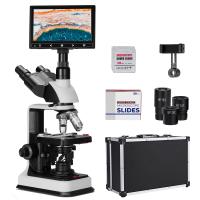
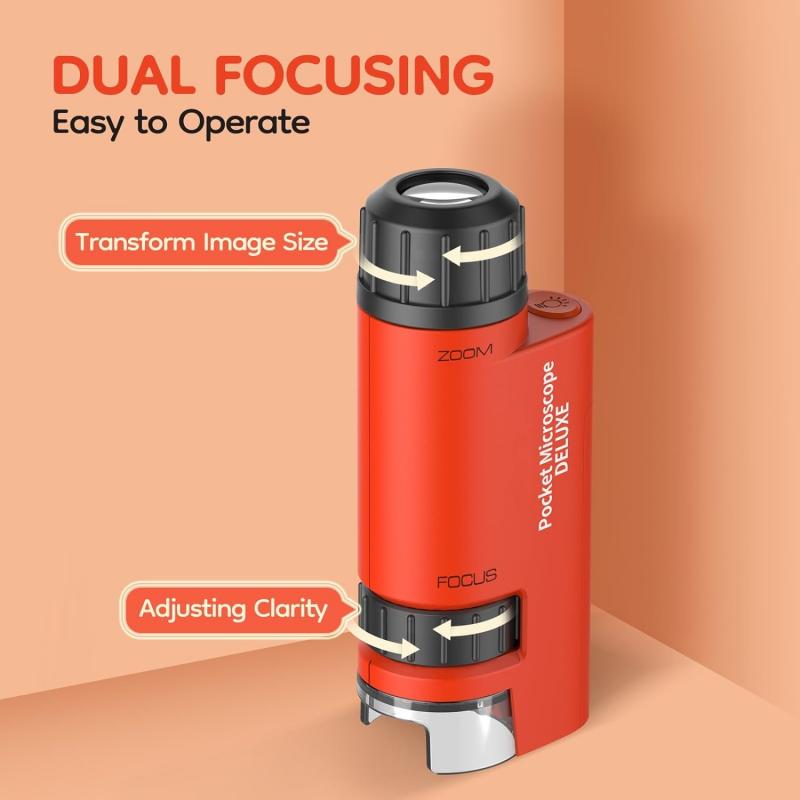
Microscopes achieve magnification through a combination of two optical systems: the objective lens and the eyepiece lens. The total magnification is derived by multiplying the magnification values of the objective and the eyepiece.
- Objective lens: This is the lens closest to the specimen. Objectives typically have magnifying powers that range from 1x to 100x, with the most common powers being 4x (or 5x), 10x, 20x, 40x (or 50x), and 100x. In surgical and dental microscopes, objective lenses are often fixed or variable, with typical values ranging from 2.5x to 10x.
- Eyepiece (ocular lens): This is the lens you look through, found at the top of the microscope. Eyepieces are classified in terms of their ability to magnify the intermediate image. Their magnification factors vary between 5x and 30x, with the most commonly used eyepieces having a value of 10x–15x.
- Total magnification calculation: Multiply the power of the objective lens by the power of the eyepiece. For instance, using a 5x objective with a 10x eyepiece yields a total visual magnification of 50x. At the top end of the scale, using a 100x objective with a 30x eyepiece gives a visual magnification of 3000x.
How the Objective Lens Forms an Image
Light passes through the specimen and into the objective, which projects a real, inverted, and magnified image of the specimen to a fixed plane within the microscope termed the intermediate image plane. This case describes the functioning of all finite tube length objectives used in microscopy: such finite tube length objectives project a real, inverted, and magnified image into the body tube of the microscope. This image comes into focus at the plane of the fixed diaphragm in the eyepiece.
The distance from the back focal plane of the objective to the plane of the fixed diaphragm of the eyepiece is known as the optical tube length of the objective. The distance from the nosepiece (where the objective is mounted) to the top edge of the observation tubes where the eyepieces are inserted is known as the mechanical tube length.

How the Eyepiece Further Magnifies the Image
The eyepiece or ocular fits into the body tube at the upper end and is the farthest optical component from the specimen. The placement of the eyepiece is such that its eye (upper) lens further magnifies the real image projected by the objective. The eye of the observer sees this secondarily magnified image as if it were at a distance of 10 inches (25 centimeters) from the eye; hence this virtual image appears as if it were near the base of the microscope.
The last case describes the functioning of the observation eyepiece of the microscope. The "object" examined by the eyepiece is the magnified, inverted, real image projected by the objective. When the human eye is placed above the eyepiece, the lens and cornea of the eye "look" at this secondarily magnified virtual image and see this virtual image as if it were 10 inches from the eye, near the base of the microscope.
How Tube Length Affects Total Magnification
Total magnification is also dependent upon the tube length of the microscope. Most standard fixed tube length microscopes have a tube length of 160, 170, 200, or 210 millimeters, with 160 millimeters being the most common for transmitted light biomedical microscopes. The objectives and eyepieces of these microscopes have optical properties designed for a specific tube length, and using an objective or eyepiece in a microscope of different tube length will lead to changes in the magnification factor and may also lead to an increase in optical aberration lens errors.
Modern research microscopes are very complex and often have both episcopic and diascopic illuminators built into the microscope housing. This is done by the addition of a set of parallelizing lenses to shorten the apparent mechanical tube length. These additional lenses will sometimes introduce an additional magnification factor — usually around 1.25–1.5x — that must be taken into account when calculating both the visual and photomicrographic magnification. This additional magnification factor is referred to as a tube factor. Thus, if a 5x objective is being used with a 15x set of eyepieces, the total visual magnification becomes 93.75x (using a 1.25x tube factor) or 112.5x (using a 1.5x tube factor).
Empty Magnification and the Limits of Optical Enlargement
- What is empty magnification?
- Empty magnification is a situation where the image is enlarged, but no additional detail is resolved. Magnifications higher than the useful maximum will yield no further useful information or finer resolution of image detail and will usually lead to image degradation.
- What causes empty magnification?
- Manufacturers may provide additional lenses — sometimes called magnification changers — that can be rotated into the optical pathway to increase the magnification factor. These lenses usually have very small magnification factors ranging from 1.25x up to 2.5x, but use of these lenses may lead to empty magnification.
- What is the useful range of total magnification?
- The range of useful total magnification for an objective/eyepiece combination is defined by the numerical aperture of the system. The minimum magnification necessary for the detail present in an image to be resolved is usually set as 500 times the numerical aperture (500 × NA). The maximum useful magnification is usually set at 1000 times the numerical aperture (1000 × NA).
- What is numerical aperture?
- Numerical aperture (NA) is the critical factor that determines a microscope's resolving ability. Magnification alone does not determine a microscope's resolving power. A higher NA means better resolution. Oil immersion lenses often have higher NA and are used when the clearest image is needed.
Limitations on Maximum Magnification
While classroom compound light microscopes theoretically offer a maximum magnification of 1000x (100x objective × 10x ocular), practical limitations may prevent achieving this level of magnification in all situations:
- Optical quality: As magnification increases, so does the risk of optical aberrations, which can distort the image. The optical quality of the lenses, especially at high magnifications, plays a crucial role in the clarity of the observed specimen.
- Depth of field: At high magnifications, the depth of field becomes extremely shallow. This means that only a thin section of the specimen will be in focus at any given time, making it challenging to observe three-dimensional structures or moving organisms.
- Resolution: Resolution, or the ability to distinguish between two closely spaced objects, also becomes a limiting factor. While the microscope can magnify the image, it may not have the resolution to clearly distinguish the details.
- Specimen preparation: High magnification requires meticulous specimen preparation. Specimens need to be thin enough to allow light to pass through and transparent enough to reveal meaningful details.
Magnification in Digital Microscopy
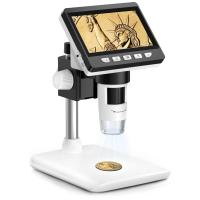
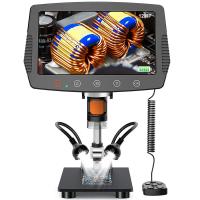
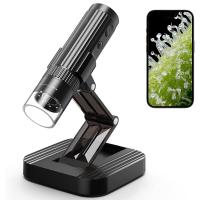
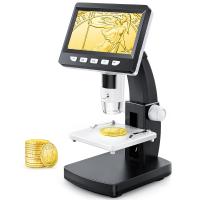
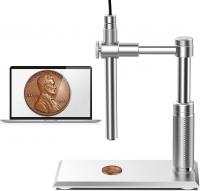
In digital microscopy, the magnification steps are achieved in a different manner. The slide is scanned — photographed in full resolution — and the resulting image can be zoomed in and out to get the best scale view of the sample. The simplicity of the continuously variable magnification of a digital zoom makes moving between an overview and the desired level of detail incredibly easy. Digitally, any part of the image can also be magnified to a size far larger than it would ever appear through an eyepiece.
Digital magnification is the process of enlarging the image captured by a microscope's camera using software. This can be done on a live video feed or a still image, and is similar to zooming in on a photo with your phone or computer. The system doesn't change the physical optics — it simply increases the size of the pixels that make up the image. Optical magnification is achieved through the physical lenses of the microscope and increases the level of detail and resolution you can actually see, whereas digital magnification scales up pixels, which can result in a grainy or blurry image where fine detail is lost.
For digital microscopy, the total lateral display magnification depends on the size of the image displayed on the monitor. The pixel size ratio is determined by the ratio of the pixel size of the monitor to that of the camera sensor. Monitor pixels are typically 40 to 325 times bigger than the camera pixels. Whenever the perceived magnification value exceeds the useful magnification range, no further details about the sample can be resolved — this is empty magnification in the context of digital microscopy as well.