How Does a WiFi Trail Camera Work?
If you love wildlife photography or hunting, you’ve probably heard about WiFi trail cameras — the next evolution in remote outdoor monitoring. These cameras combine the stealth and durability of traditional trail cameras with the convenience of modern wireless technology. But how does a WiFi trail camera work? And what are the benefits of using one in the field?
In this detailed guide, we’ll explain everything you need to know about WiFi trail cameras, how they function, and why the K&F Concept 4K WiFi Trail Camera is one of the best options available for wildlife enthusiasts and hunters alike.
.jpg)
What Is a WiFi Wildlife Camera?
A WiFi wildlife camera — also called a WiFi trail camera or WiFi game trail camera — is an advanced type of trail camera equipped with built-in WiFi and sometimes Bluetooth technology. Like traditional trail cameras, these devices are designed to capture photos and videos of animals automatically when motion or heat is detected.
However, unlike older models that require you to remove the SD card to check your footage, a trail camera with WiFi allows you to connect directly to your smartphone or tablet via a dedicated app. This means you can view, download, and share your wildlife photos instantly, without disturbing the camera setup or leaving your scent behind in the field.
Modern trail cameras with WiFi can record in ultra-high resolution (2.4K, 4K, or higher), offer night vision, and operate for months using batteries or solar panels. They’re ideal for wildlife observation, hunting, or even home and farm security.
Common types of trail cameras with WiFi include:
l WiFi-only cameras – connect directly to your phone when you’re within WiFi range (usually 10–20 meters).
l Cellular trail cameras – use a SIM card to send photos and alerts remotely via a mobile network.
l Hybrid WiFi game trail cameras – combine WiFi, Bluetooth, and high-quality optics for the best of both worlds.
What Are the Benefits of a WiFi Wildlife Camera?
Upgrading to a WiFi trail camera brings several advantages for hunters, photographers, and nature enthusiasts. Here are the top reasons why trail cameras with WiFi are becoming essential outdoor tools.
1. Instant Wireless Access
The most obvious benefit of a trail camera with WiFi is that you can access your images and videos without touching the camera. Simply connect via the camera’s WiFi signal to your mobile device and view or download everything in real-time.
This feature is especially useful when the camera is mounted high in a tree, near water, or in an area where wildlife is easily disturbed.
2. No Need to Disturb Wildlife
Traditional cameras require you to physically retrieve the SD card, which often leaves human scent and scares animals away. With a WiFi game trail camera, you can stay hidden while checking footage remotely — ensuring animals behave naturally in front of the lens.
3. High-Quality Photos and Videos
Most WiFi trail cameras come with powerful sensors and lenses capable of 2.4K or 4K resolution. That means you’ll capture sharp details of animal fur, feathers, or even nighttime behavior — perfect for research or social media sharing.
4. Easy Setup and Remote Control
Modern trail cameras WiFi models often include smartphone apps that let you adjust settings remotely. You can change the resolution, motion sensitivity, trigger speed, or even format the SD card directly from your phone.
5. Multi-Purpose Use
Besides wildlife monitoring, a trail camera WiFi system can also be used for:
l Home security
l Farm and property monitoring
l Outdoor project documentation
l Hiking or campsite observation
6. Energy Efficiency
Many WiFi trail cameras feature low-power standby modes and can operate for weeks or months on standard AA batteries or a solar-powered setup.
How Does a WiFi Trail Camera Work?
Let’s dive into the core of this guide — how does a WiFi trail camera work in the field?
A WiFi trail camera combines motion detection, image processing, and wireless connectivity to automatically capture and transmit wildlife footage. Here’s a step-by-step breakdown.
1. Motion or Heat Detection
Most trail cameras with WiFi use a PIR (Passive Infrared) sensor to detect motion and body heat. When an animal enters the detection zone, the PIR sensor triggers the camera’s lens and image processor.
The detection range can be up to 120° and 60–80 feet, depending on the model. For example, the K&F Concept WiFi Trail Camera features a 120° wide-angle PIR sensor for maximum coverage.
2. Capturing the Image or Video
Once triggered, the camera captures photos or records videos instantly — usually within 0.2 seconds. High-end WiFi trail cameras can shoot 4K video and 32MP still photos, producing vibrant and detailed footage.
3. Saving to SD Card
The recorded media is saved to an internal microSD card, typically supporting up to 64GB or 128GB. Some models come with a pre-installed U3 64GB SD card, ensuring smooth 4K video recording.
4. WiFi Connection to Your Phone
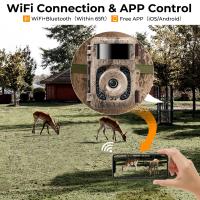
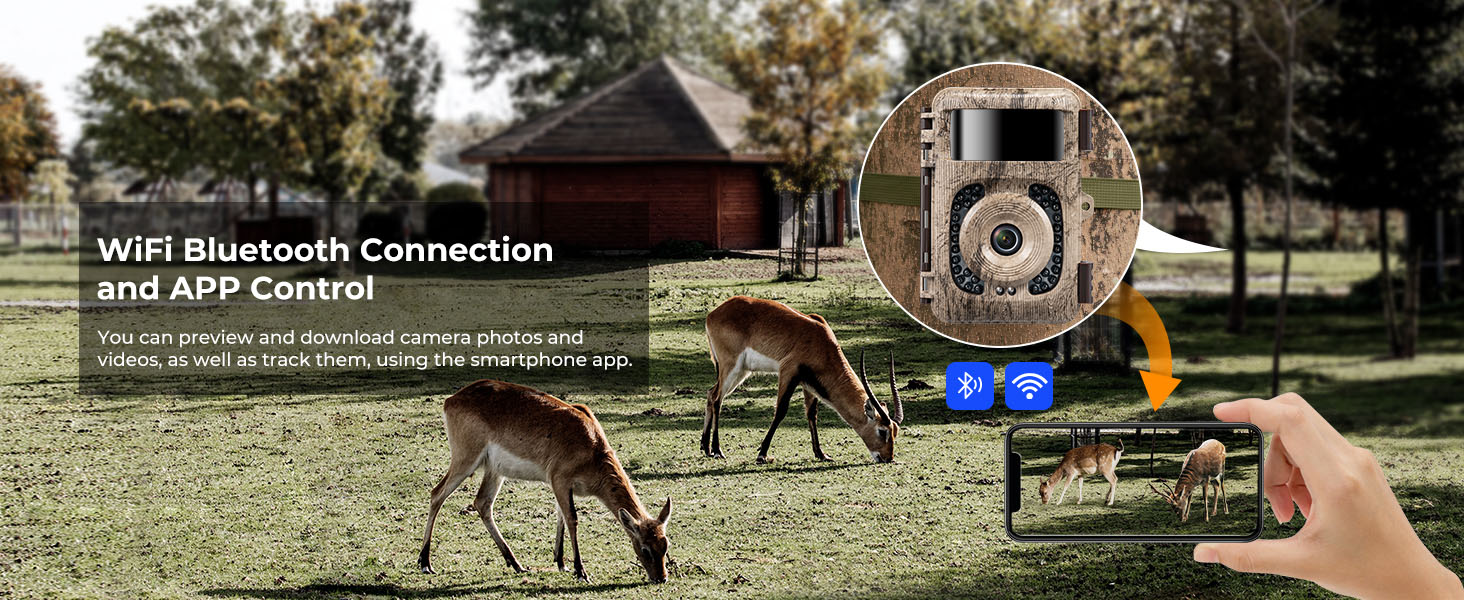
Now comes the smart part — WiFi connectivity. A trail camera with WiFi generates its own local WiFi signal. You can connect your smartphone to this signal using the camera’s app (for example, the K&F Concept app).
Once connected, you can:
l Preview real-time footage
l Download images or videos
l Change settings remotely
l Check battery or SD card status
5. Bluetooth for Quick Pairing
Some WiFi trail cameras include Bluetooth technology that allows faster pairing. You use Bluetooth to establish the initial connection, and then the app automatically switches to WiFi for high-speed data transfer.
6. Low-Light and Night Vision
For 24-hour monitoring, WiFi trail cameras include starlight night vision or infrared LEDs that illuminate the area without scaring animals. The K&F Concept WiFi Trail Camera uses starlight night vision for colorful nighttime shots.
7. Weatherproof and Durable Design
Since these cameras are used outdoors, they are built to withstand extreme weather. Look for models rated IP66 waterproof or higher — like the K&F Concept 4K WiFi Trail Camera — to ensure durability in rain, snow, or dust.
In summary, the process of how WiFi trail cameras work involves seamless automation: detect → capture → store → connect → view — all without human interference.
How to Use a WiFi Trail Camera?
Learning how to use a WiFi trail camera properly can make a big difference in your results. Here’s a quick step-by-step guide for beginners:
Step 1: Choose the Right Location
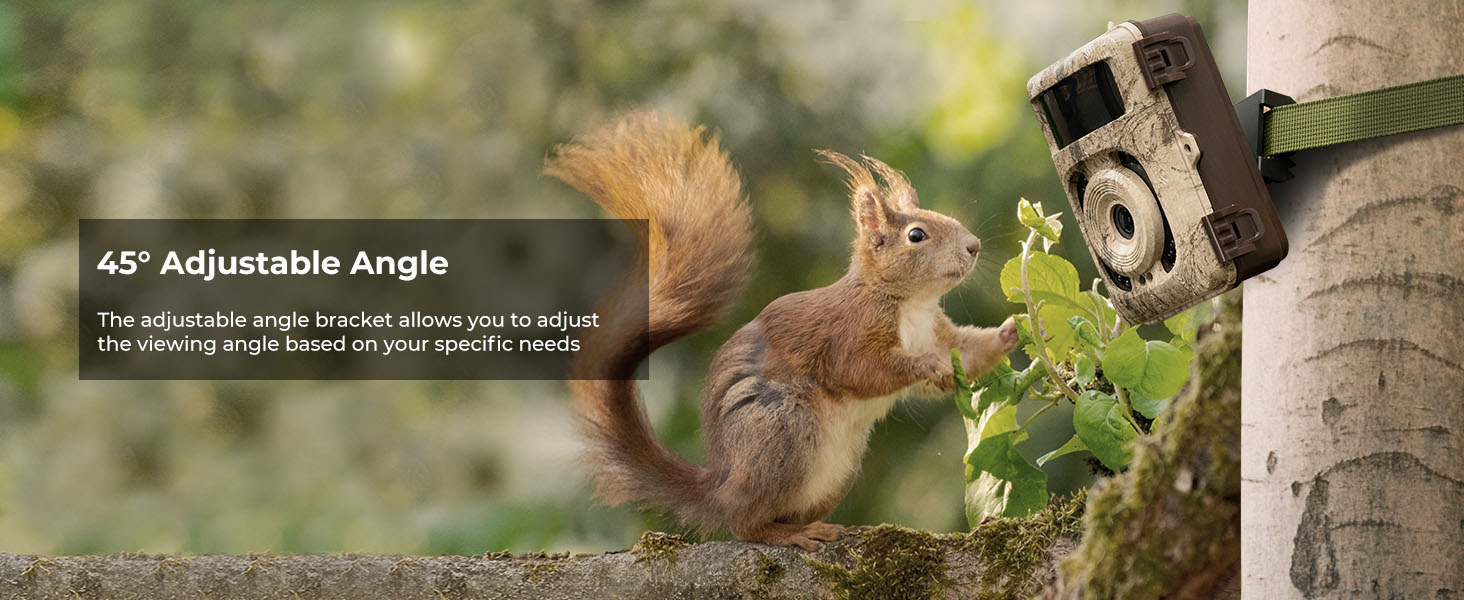
Place the trail camera WiFi near animal trails, feeding spots, or water sources. Mount it 3–4 feet above the ground and angle slightly downward to capture the full scene.
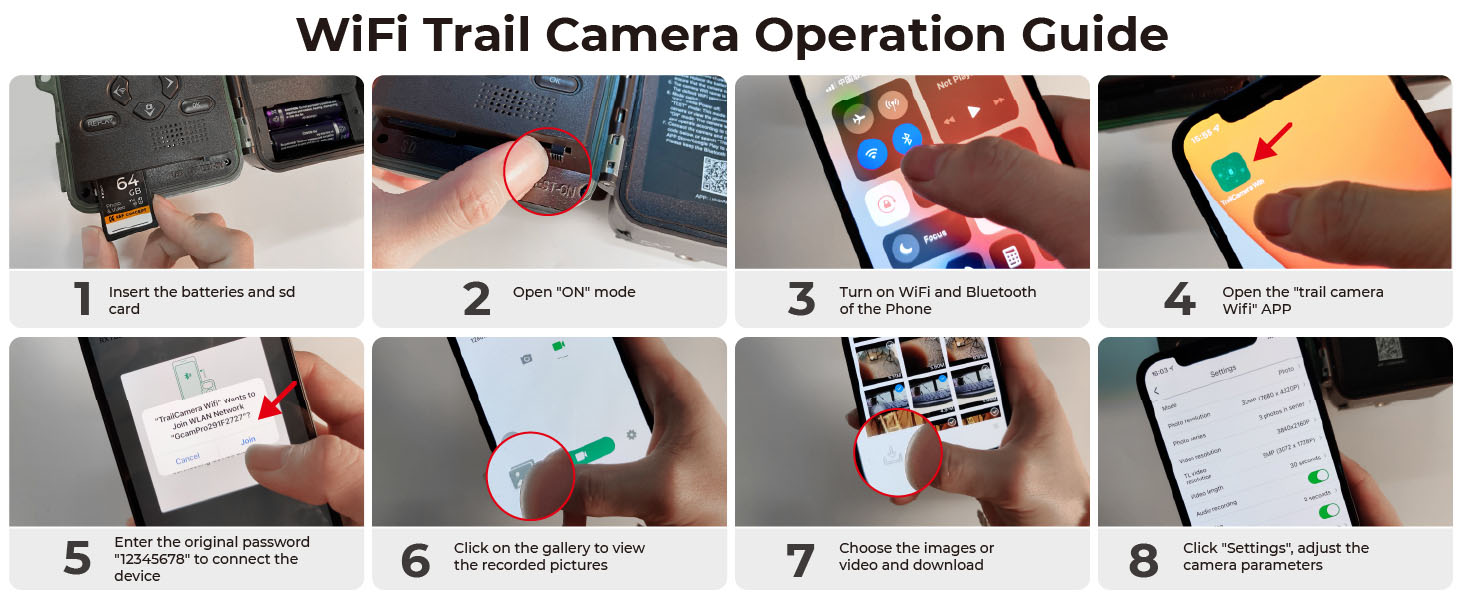
Step 2: Install Batteries and SD Card
Insert high-quality AA batteries (preferably lithium) and a compatible U3 SD card. Many modern WiFi game trail cameras support up to 64GB or 128GB.
Step 3: Activate WiFi and Pair Your Device
Turn on WiFi and Bluetooth via the camera’s menu. Open the companion app on your phone and connect to the camera’s WiFi network. Once connected, you can configure settings like:
l Image resolution (up to 32MP)
l Video resolution (up to 4K)
l Trigger speed
l Recording length
l PIR sensitivity
Step 4: Test and Adjust
Before leaving the camera unattended, trigger a few test shots to ensure the angle, exposure, and motion detection are optimized.
Step 5: Monitor and Download
Whenever you return to the area, reconnect your smartphone to the camera’s WiFi signal and download photos or videos directly. No need to touch or move the device — which is perfect for minimizing human scent and disturbance.
Step 6: Maintenance
Clean the lens periodically, replace batteries when needed, and check firmware updates in the app to keep your WiFi trail camera performing at its best.
Best WiFi Trail Camera: K&F Concept 4K WiFi Bluetooth Game Camera
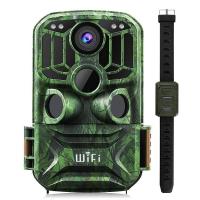
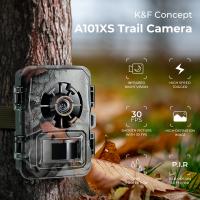
K&F Concept 4K WiFi Trail Camera is one of the best WiFi trail cameras available today for hunters and wildlife photographers.
Key Features:
l Resolution: 4K video + 32MP photos
l Trigger Speed: 0.2 seconds
l Detection Angle: 120° wide angle
l Connectivity: WiFi + Bluetooth for easy control
l Night Vision: Starlight color night vision
l Storage: Includes U3 64GB SD card
l Power: 8 AA batteries
l Waterproof: IP66 rated for outdoor durability
Why It’s the Best WiFi Trail Camera
The K&F Concept WiFi game trail camera combines advanced optics with modern convenience. Its dual wireless system (WiFi + Bluetooth) ensures smooth connection and control through the app. The 4K Ultra HD recording captures lifelike wildlife moments both day and night, while the starlight sensor enhances color even in low-light environments.
This model is not only one of the best WiFi trail cameras for wildlife monitoring but also a reliable choice for security or research applications.
Conclusion
Understanding how a WiFi trail camera works helps you make smarter decisions when choosing your next device. These cameras blend traditional motion detection with modern wireless connectivity, giving you real-time access to your wildlife footage — without ever disturbing the environment.
Whether you’re a hunter, nature lover, or security-conscious homeowner, a trail camera with WiFi offers unmatched convenience and performance. And among all options, the K&F Concept 4K WiFi Trail Camera stands out as a powerful, durable, and feature-packed choice.
With features like 4K resolution, WiFi and Bluetooth connectivity, starlight night vision, and IP66 waterproofing, it’s no wonder that K&F Concept leads the way in best WiFi trail cameras today.