How To Adjust Scope For Range?
2026-07-13 00:56:10
0 Comments
MOA and Range Adjustment
- so i understand that 1 moa is 1" at 100yds i get that. and 2" at 200yds is also 1moa yup that makes sense.
- what i don't understand is say i take aim at a target that is 300yds away and i am trying to hit a 1" group, 3" is 1 moa at 300yds so would i adjust my scope for 3 moa to hit the centre of a 300yd target? not including windage and elevation etc just for distance.
- 1 moa is 1" at 100yds so to hit a target in the centre of my cross-hair at 300yds i would have to be clicked to 3 moa right?
- moa . let's say you zero your rifle so that at 100yds, you are right on the bullseye. if you then shoot at 300yds, your bullet is going to hit the target likely below the bullseye since it's a further distance shot. you measure the distance from the bullseye to the new impact spot in moa to determine your adjustment.
- example: with a 100yd zero
- you shoot at 300yds and your impact is 6" below the bullseye. like you understand it, 1 moa at 300yds is 3". since it's 6" below, you need to adjust your scope for elevation of 2 moa. most moa scopes are 1/4 moa per click. so in that case, 8 clicks of elevation are needed.
- bullet drop you need to compensate for, which is determined by speed and kinetic energy of your bullet. so if, for example your shot is 15” low at 300 yards, then you will need to adjust your scope by 15”/3”=approx. 5 moa to be back on center.
- also, a minor note - 1 moa is not 1" at 100 yards, it's actually 1.047" - and that extra .047" adds up.
MOA vs. MIL Scopes
- moa scopes:
- inch-based measurements
- 1 moa ≈ 1.047 inches at 100 yards.
- scope adjustments are often in ¼ moa per click increments.
- preferred by most recreational shooters and hunters for its standard terminology and ease of understanding..
- mil scopes:
- metric-based measurements
- 1 mil = 10 centimeters at 100 meters (~3.6 inches at 100 yards).
- adjustments are often in 0.1 mil per click increments
- popular among former military and law enforcement shooters who were trained on mil scope systems, as well as competitive shooters.
- both systems work effectively, and determining which one to use is ultimately up to personal preference. once you pick a system you like, continue to use it and stick to it! make sure that your calculations also match the system you are using to avoid confusion and wasted time.
- ok so if it was mils and it was 1/10 mils per click. then it would be 20 clicks?
Elevation Adjustment
- zeroing: how to adjust a rifle scope's elevation
- to adjust the scope's elevation and move the poi up, you simply turn the scope's elevation turret in the “up” direction.
- for many scopes, this means rotating the turret counterclockwise.
- as you turn the turret, listen for a clicking sound.
- each click signals an angular measurement known as the minute of angle (moa), often representing one-quarter of an inch per 100 yards.
- however, be sure to inspect your personal scope to be sure.
- the combination of this clicking noise and an exposed turret allows you to make elevation adjustments while peering through the scope and holding position.
- just remember the expression “righty tighty, lefty loosey” to help you understand that turning the turret counterclockwise raises the poi elevation, and clockwise lowers the poi.
- sometimes, your turret adjustments can appear to be out of whack, working in reverse of the way they are designed.
- if this happens, it means you also need to adjust your reticle.
- when you turn the turret up, the reticle should go down inside the scope, and then you should manually raise or lower the rifle accordingly.
Windage Adjustment
- windage adjustments are similar to your scope's elevation adjustments.
- the key difference is that while elevation is intended for raising and lowering a bullet's impact, windage is meant for adjusting the bullet left to right.
- as the name implies, the windage adjustment helps combat strong wind conditions that could offset the bullet from the desired target.
- many shooters leave the windage alone, focusing more on the elevation turret.
- while at great distances, strong winds can push a bullet mid-flight, touching the turret isn't necessary.
- instead, many shooters find it more advantageous to simply adjust the rifle itself.
- one reason is that strong winds can often get squirrely, constantly shifting direction.
- changing a turret with each wind gust is much more challenging than ever-so-slightly shifting your rifle with your hands.
- the windage turret is often found on the side of the scope body.
- like the elevation turret, the windage turret has an easy way to remember how it's designed to be adjusted.
- use the mnemonic device: i don't want to be left out, so i'll be right back.
- in other words, rotating the windage turret out or away adjusts the scope left. and turning the turret back toward you adjusts the scope right.
Ballistic Calculator and Rifle Information
- what you need is a ballistics calculator.
- there's plenty of them available (both free and paid for - strelok, hornady 4dof, and applied ballistics mobile are popular options) for phones and even on websites (google: jbm ballistics).
- you will need to input the ballistic coeffecient (bc) of the projectile you're using (many calculators have a library to pick from with this info selected), the weight, length, and diameter of the projectile (not the loaded cartridge - just the projectile), your muzzle velocity (best measured with a good chronograph, but you can use the estimate on a box of factory ammo as a starting point), the height of your scope over your barrel (measured from center of bore to center of scope), and what range you zeroed the scope at.
- you'll need to input that information into your calculator, and it can then calculate the given drop for your rifle at a given distance.
- as you get the basics under control, you'll start to be concerned about inputting barometric pressure, humidity, temperature, wind speed and direction, direction of fire, and a few other details to fine tune that info from your calculator.
- if you make any changes to the above info (bullet selection, velocity, etc) you will need to update your calculator with those changes.
- download the strelok app for your phone and play with it.
- it will make you understand the concepts much better.
Making the Scope Adjustment
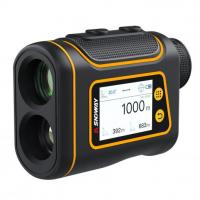
- find the range of your target with a rangefinder, or use your scope reticle if it has range-finding capabilities.
- measure other environmental factors with your weather meter, or use a weather app for the approximate windspeed at your location.
- input the distance and other information into your ballistic calculator, and consult your d.o.p.e. card for previous observations.
- dial your scope adjustment based on your ballistic calculator and/or d.o.p.e. information.
- squeeze the trigger and observe your shot for any further corrections.
- ballistic calculator: having a ballistic calculator with your ammunition and rifle information dialed and ready to go can help you make a quick, accurate adjustment. all you need is the distance to your target.
- rangefinder: having a rangefinder is non-negotiable for making accurate long-range shots. they provide near instant feedback of your target’s distance for dialing in your scope adjustment.
- weather meter: a weather meter is a device that provides a readout of environmental factors like wind speed and relative humidity, helping you make precise adjustments.
- custom turrets: while not a necessary addition, some manufacturers can provide custom scope turrets that are dialed to your specific rifle and ammunition load, helping to ensure accurate adjustments.
Point of Aim and Group Size
- i think you might also be mistaking group size for elevation and windage needed.
- you can have rifle that will shoot a small group size and one that with less accuracy that will shoot larger group size.
- when zeroing you want to shoot a group, find the center of the group and then adjust so that the center of the next group is where you want it on the target.
- except when zeroing, ignore inches and feet, instead use the marks on your scope reticle to measure.
- actually you can do this when zeroing as well.
- now you don't have to think about inches and feet.
- you measure and you can use the turrets to move were you need to go.
Scope, Barrel, and Bullet Path
- another thing that might help.
- something that really helped me understand the ballistic path relative to my scope is this concept someone kindly explained to me at the range.
- if the center of your scope is 2” above the center of your barrel, and you are zero’d at, say, 50yd, at 100yd, the bore will be pointed 2” above the target crosshair on your scope before any adjustments and the bullet will hit just under 2” above the bullseye.
- picture two lines coming out of the rifle - one from the scope one from the barrel - intersecting on the zero.
- not exactly sure if it’s the same idea as you’re asking but it helps have an idea of expected point of impact when changing distances.
- 2 lines and a curve.
- one line is a straight line where the barrel is pointed, one line is the straight 'line of sight' line where the scope is pointed (and the point where that line hits our target is our point of aim), and the curved line that is the ballistic trajectory of the bullet.
- when you make adjustments to the scope (either by adjusting the turrets or using a different mark on the reticle to aim), you are making tiny adjustments to the angle between those 2 straight lines, so that we adjust where the sight line and the ballistic arc meet (we want them to meet on the target).
Leave your comment
Note: HTML is not translated!