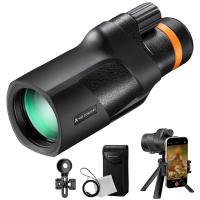
Which Monocular Magnification Is Better?
Understanding monocular magnification
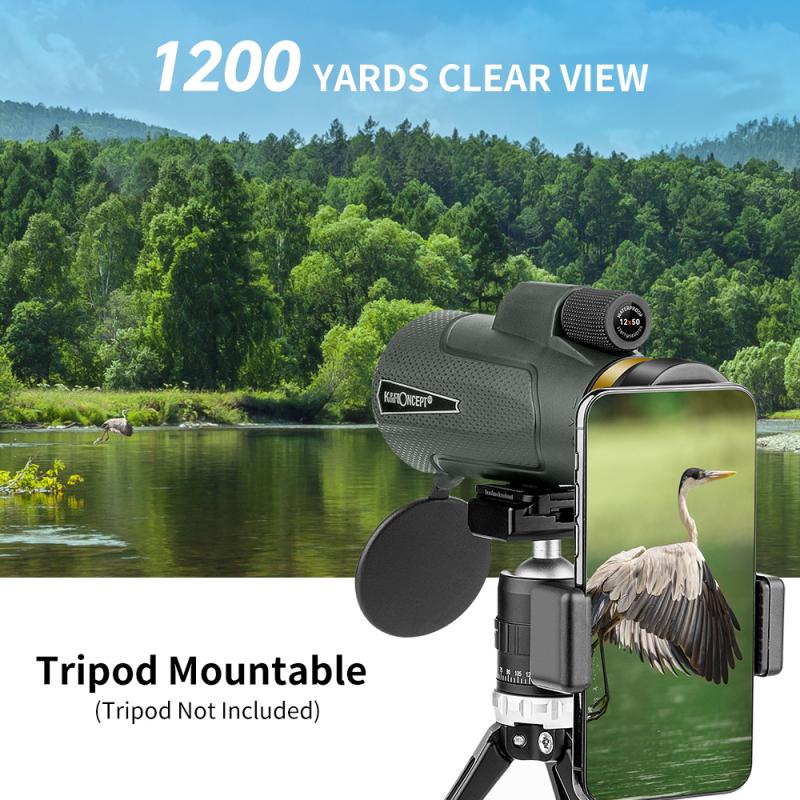
- the specification of a monocular is indicated by two numbers.
- the first number is the magnification power of the monocular; the second is the diameter of the monoculars objective, or front lens.
- these two elements effect how the monocular will perform in different circumstances and also the size of the monocular.
example: a monocular with a specification of 8×25
- magnification power
- this monocular will have a magnification power of 8, meaning that an object will appear 8 times closer than it would to your unassisted eye.
- for example, if you view a buck that stands 50 metres away from you through a 8x42 monocular, it will appear as though it were only 6.25 meters away (50 divided by 8).
- monoculars with higher magnification will allow you to see further and in more detail.
- the great thing about monoculars is that you get the same power of binoculars with only half of their size.
- for example, in an 8x25 monocular (or binocular) "8x" refers to the magnification power, which means that the image will appear 8 times closer than it does to the naked eye.
- the "25" refers to the diameter of the objective lens in millimeters, which is the lens at the front of the monocular.
- the same rule applies to all other sizes such as a 10x42, 8x42, ...
Higher magnification, field of view, and stability
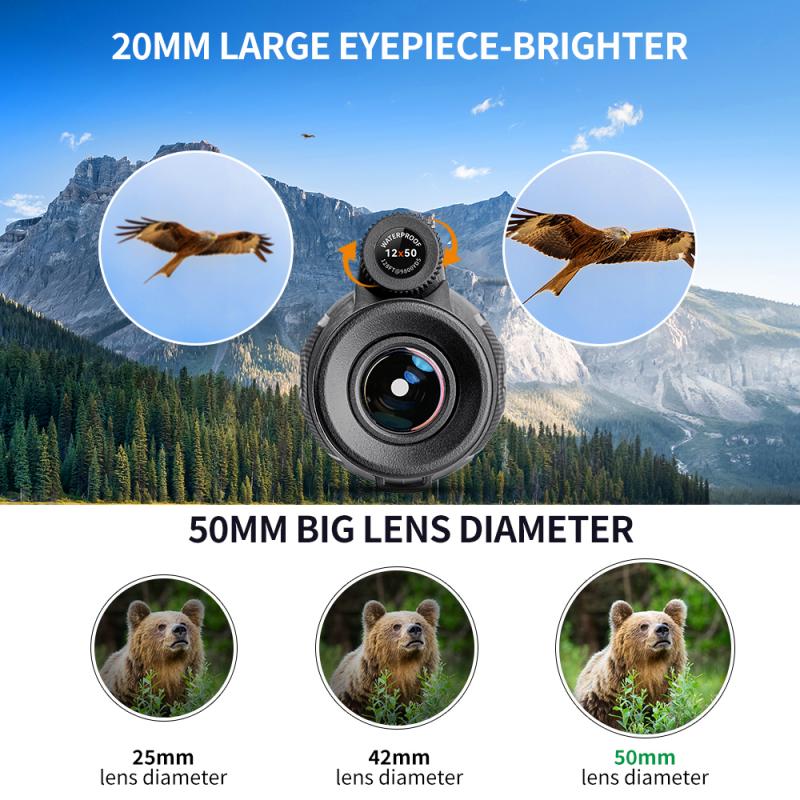
- decide how much magnification power you need.
- if you want monoculars with higher magnification power, you may go for a monocular with a 9x or a 10x magnification.
- you may opt for higher magnification power if you are experienced with using binoculars, spotting scopes, and monoculars.
- keep in mind that as the magnification power gets higher, your field of view goes down.
- so you may opt for a monocular with lower magnification power if you want a wide field of view.
it's important to note that while a higher magnification can bring objects closer, it can also make the image appear shakier or harder to focus.
- monoculars with higher magnification will allow you to see further and in more detail.
- keep in mind that as the magnification power gets higher, your field of view goes down.
- while a higher magnification can bring objects closer, it can also make the image appear shakier or harder to focus.
8x, 9x, and 10x magnification
- most monoculars have a magnification between 5 and 10.
- 5-8 is great for normal use and will give you a wider field of view, but if you’ll be looking at things really far away, you’ll want to go for 9 or 10 times magnification.
- a good beginner monocular would be 8 times magnification with a 25 millimeter lens.
- i would suggest that you consider the 8x over the 10x because of the greater depth of field it will have, especially on close objects under 70' or so from you.
- your focusing won't be as critical with the 8x.
- their wider field of view will also be handier too.
- and it will also be marginally brighter in low light conditions because of it's slightly larger exit pupil.
the 8x magnification might be insufficient for those needing higher magnification, though a 10x option is available from the same manufacturer.
- yes - but that difference (specifically in the context of birdwatching) would be only the choice between 8x or 10x.
- this is also largely personal preference, and many would still rather 8x in all environments, whereas others would opt for 10x in more open areas.
- handheld birdwatching optics 8x and 10x zoom are the only viable/widely used options.
- any higher magnification than that and you are getting into tripod territory.
- once you get over 10x handheld it’s too shaky for birds.
20x and high-power magnification
- don’t know why you would ever carry something with 20x magnification.
- no birdwatcher on this planet uses 20x binoculars.
- 8x is plenty.
- you will find that 20x magnification is way too shaky without a tripod.
- hence why birdwatchers almost always opt for 8x or 10x zoom binoculars.
monoculars have a much lower magnification than spotting scopes, with the magnification power of monoculars usually being 7x, compared to that of a spotting scope which is usually 20x or higher.
- spotting scopes are an important tool for many backcountry hunters/skiers/etc but require the tripod to be stable enough.
- while some professional guides are quite quick at deploying them, i do not think they are suitable for most birdwatching applications.
- a monocular may seem lighter but with the shakiness, and the loss of fov i think you'd be better off with the tool of the trade-binoculars.
Lens size and brightness
- objective lens diameter
- the second number used in monocular identification refers to the monoculars objective lens diameter.
- the objective lens is the lens at the front of the monocular, furthest away from your eyes, and closest to what you are looking at.
- the objective lens diameter of the example monocular is 25mm.
- the diameter of the objective lens largely determines how much light your monocular can gather.
- the larger the objective lens diameter, the more light that the monocular will capture.
- more light means a brighter view, particularly in low-light conditions.
- the downside is that the bigger the lens is the heavier and bulkier your monocular will be.
- users who want to enjoy a wider, sharper and brighter image often opt for lenses that have an objective lens diameter of 30mm or over.
- a larger objective lens diameter generally allows more light to enter the monocular and can result in a brighter image.
- additionally, a larger objective lens can make the monocular or binocular heavier and bulkier.
- so, it's important to choose the right combination of magnification and objective lens diameter that suits your needs and preferences.
Size, portability and magnification
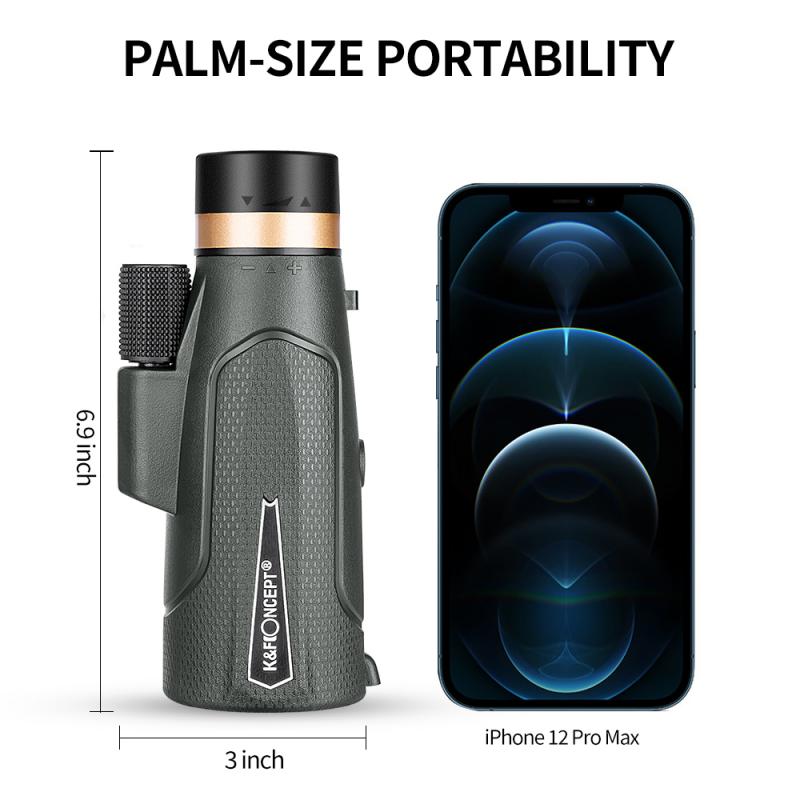
- monoculars are significantly smaller and lighter than spotting scopes.
- monoculars have a much lower magnification than spotting scopes, with the magnification power of monoculars usually being 7x, compared to that of a spotting scope which is usually 20x or higher.
- determine if you want a small or a large monocular.
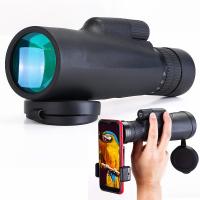
- an 8 x 25 or 10 x 25 monocular are considered pocket or compact models.
- you can slip a compact monocular in your bag, in your pocket, or keep it in your car.
- larger monoculars that are 9 x 30 or 10 x 42 may require a larger carrying bag and are often set up on a tripod.
- look at the weight of the monocular.
- you may try several different sized monoculars to get a sense of their weight and girth.
- if you are planning to carry the monocular around with you often, you may not want to get a model that is too heavy or bulky.
Trying magnification before choosing
- determine the lens size.
- you may find that monoculars come with a specific magnification power and lens size, such as an 8 x 25, which is a monocular with an 8x magnification and a 25mm lens.
- you may try out several different monoculars with a set magnification power and lens size to get a sense of what you are looking for.
- try out the monocular before you buy it.
- you should go in person to several retailers and try the monoculars yourself before you buy one.
- hold the monocular in your hand to feel its weight and size.
- slip it in your pocket and see how comfortable it feels.
- put the monocular to your eye to make sure the eye relief is a fit for you.
you may try out several different models to get a sense of what will suit your needs. do not be afraid to ask a salesperson to let you hold the monocular and try it out in the store. notice the magnification power and the lens on the monocular. make sure it is a good fit for you.

![[4X Optical Zoom] Recharge power Security Camera PTZ Outdoor for Home Security with Human Detection Auto Tracking-EU Standard](https://img.kentfaith.com/cache/catalog/products/us/KF50.0003/KF50.0003-1-200x200.jpg "[4X Optical Zoom] Recharge power Security Camera PTZ Outdoor for Home Security with Human Detection Auto Tracking-EU Standard")