What Are The Magnifications On A Microscope?
Magnification: how large can you see?
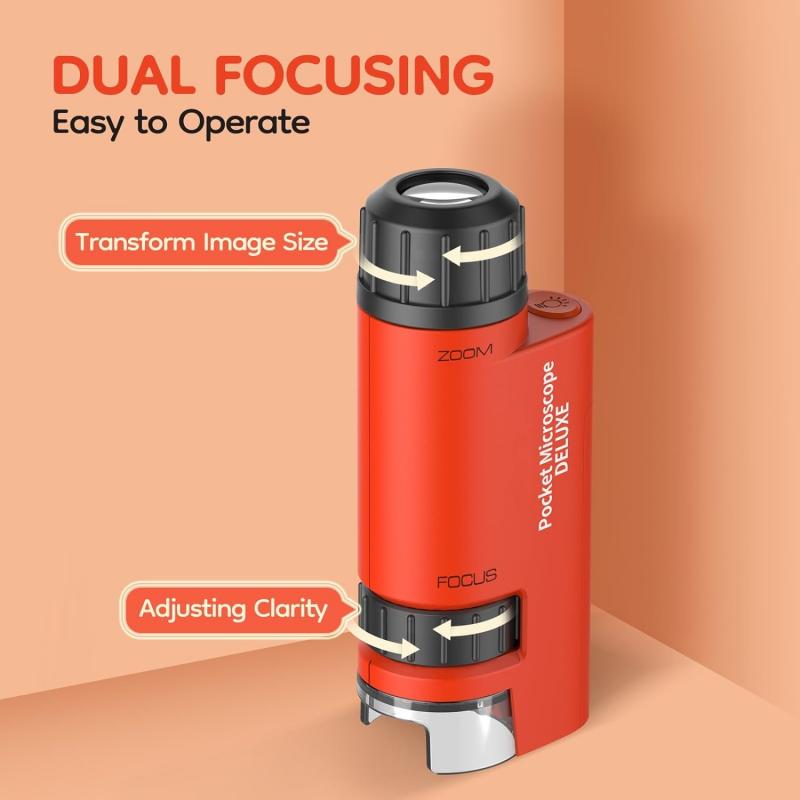
Magnification tells us how much bigger an object appears under a microscope compared to its real size. this is done using two sets of lenses:
-
objective lens
this is the main lens close to the specimen. objective lenses come in different powers:
- 4x or 10x (low-power): great for scanning larger areas.
- 40x (high-power): good for seeing more detail in cells.
- 100x (oil immersion): used for the highest magnification and resolution. requires a special oil to reduce light refraction and improve clarity.
-
eyepiece (ocular lens)
this is the lens you look through. it usually has a 10x magnification, but some may be different. in digital microscopes, the eyepiece may be replaced by a built-in camera and a screen to view the image.
Objective lens magnifications

objectives typically have magnifying powers that range from 1:1 (1x) to 100:1 (100x), with the most common powers being 4x (or 5x), 10x, 20x, 40x (or 50x), and 100x.
- low-power (4x - 10x): used for scanning large areas of a slide.
- high-power (40x): ideal for detailed study of cells or bacteria.
- oil immersion (100x): used for maximum resolution, with special oil between the lens and slide to reduce light loss.
classroom microscopes typically come equipped with three to four objective lenses, each with a different magnification level. these objective lenses are commonly labeled 4x, 10x, 40x, and sometimes 100x. the numbers represent the lens' magnification power, where 4x magnifies an object four times its actual size, 10x magnifies ten times, and so on.
Eyepiece magnifications

eyepieces, like objectives, are classified in terms of their ability to magnify the intermediate image. their magnification factors vary between 5x and 30x with the most commonly used eyepieces having a value of 10x-15x.
- usually offers 10x magnification.
- some microscopes offer different magnifications or even built-in digital cameras to capture images or video.
the ocular lens, found at the top of the microscope, often has a standard magnification of 10x. this means that when viewing through the eyepiece, the image appears ten times larger than its actual size.
a standard microscope eyepiece magnifies an object 10x. however, you can find eyepieces that magnify 15x, 20x and even 30x or higher.
Total magnification
to find the total magnification, multiply the power of the objective lens by the power of the eyepiece.
- example: a 40x objective lens × 10x eyepiece = 400x total magnification.
- total magnification = objective lens × eyepiece lens
- so, if you’re using a 4x objective and a 10x eyepiece: 4 × 10 = 40x total magnification
total visual magnification of the microscope is derived by multiplying the magnification values of the objective and the eyepiece. for instance, using a 5x objective with a 10x eyepiece yields a total visual magnification of 50x and likewise, at the top end of the scale, using a 100x objective with a 30x eyepiece gives a visual magnification of 3000x.
in order to measure the total magnification, you must calculate the product of the ocular lens and the objective lens. to do this, record the magnification of the ocular lens in the eyepiece and record the magnification of the objective lens (these numbers are usually engraved on the sides of both types of lenses). next, multiply the ocular lens magnification by the objective lens magnification. this will give you the total magnification. for instance, if you are using an ocular lens with 10x magnification and an objective lens with 50x magnification, your total magnification is 500x.
Common magnification combinations
- 4x objective lens × 10x eyepiece = 40x total magnification.
- 40x objective lens × 10x eyepiece = 400x total magnification.
- 100x objective * 10x ocular = 1000x.
- 5x objective with a 10x eyepiece yields a total visual magnification of 50x.
- 100x objective with a 30x eyepiece gives a visual magnification of 3000x.
Adjusting magnification
most compound light microscopes have two types of lenses–the ocular lens and the objective lens. the ocular lens is the lens on the eyepiece. the objective lens is the lens closest to the object or slide being observed. most microscopes have a rotating disc with at least three objective lenses attached, so the observer can choose an appropriate magnification.
to adjust the magnification, simply switch out the ocular and/or the objective lenses until you find the ideal combination for viewing your sample or slide. remember, the highest magnification is not always the best, as compound light microscopes can really only magnify up to a certain point before the images lose clarity and become unreliable.
Higher magnification and limits
however, bigger doesn’t always mean better. high magnification alone doesn’t guarantee a clear image. that’s where resolution matters.
- field of view: higher magnification narrows what you can see.
- depth of field: the range in focus becomes shallower.
- working distance: the space between the lens and specimen gets smaller, which can be tricky for surgical or dental procedures.
analog microscopes that use light and mirrors to magnify objects usually max out at about 1,500x magnification. this is because light wavelengths cause the image to appear unclear at that magnitude of magnification. electron microscopes, however, can produce images that exhibit impressive clarity all the way up to 200,000x magnification since electrons have much shorter wavelengths.
while the theoretical maximum magnification is 1000x, achieving this level of magnification is not always practical due to several factors:
- optical quality: as magnification increases, so does the risk of optical aberrations, which can distort the image. the optical quality of the lenses, especially at high magnifications, plays a crucial role in the clarity of the observed specimen.
- depth of field: at high magnifications, the depth of field becomes extremely shallow. this means that only a thin section of the specimen will be in focus at any given time. it can be challenging to observe three-dimensional structures or moving organisms under such conditions.
- resolution: resolution, or the ability to distinguish between two closely spaced objects, also becomes a limiting factor. while the microscope can magnify the image, it may not have the resolution to clearly distinguish the details.
- specimen preparation: high magnification requires meticulous specimen preparation. specimens need to be thin enough to allow light to pass through and transparent enough to reveal meaningful details.
Useful total magnification
the range of useful total magnification for an objective/eyepiece combination is defined by the numerical aperture of the system. there is a minimum magnification necessary for the detail present in an image to be resolved, and this value is usually rather arbitrarily set as 500 times the numerical aperture (500 × na). at the other end of the spectrum, the maximum useful magnification of an image is usually set at 1000 times the numerical aperture (1000 × na).
magnifications higher than this value will yield no further useful information or finer resolution of image detail, and will usually lead to image degradation, as discussed above. exceeding the limit of useful magnification causes the image to suffer from the phenomenon of empty magnification, where increasing magnification through the eyepiece or intermediate tube lens only causes the image to become more magnified with no corresponding increase in detail resolution.
Digital magnification
digital magnification is the process of enlarging the image captured by a microscope’s camera using software. this can be done on a live video feed or a still image, and is similar to zooming in on a photo with your phone or computer. the system doesn’t change the physical optics—it simply increases the size of the pixels that make up the image.
- optical magnification is achieved through the physical lenses of the microscope. it increases the level of detail and resolution you can actually see.
- digital magnification scales up pixelation—a grainy or blurry image where fine detail is lost.
in digital microscopy the magnification steps are achieved in a different manner. the slide is scanned, i.e. photographed in full resolution and the resulting image can be zoomed in and out to get the best scale view of the sample. the simplicity of the continuously variable magnification of a digital zoom makes moving between an overview and the desired level of detail incredibly easy.