Where To Buy Solar Filter For Camera?
If you’re buying a solar filter for a camera, the safest route is to buy from a specialist astronomy or photography retailer, not a random marketplace listing with vague claims. A proper solar filter is not just a “dark filter.” It has to reduce visible light, infrared, and ultraviolet to a safe level before sunlight enters the lens.
For most photographers, the best places to look are:
- Dedicated astronomy shops
- Reputable camera stores
- The manufacturer’s own website
- Well-known telescope retailers
- Established photography dealers that clearly list certified solar filters
Avoid mystery-brand filters with no technical details, especially if they only say things like “for eclipse photography” or “ND filter for sun.” That wording is not enough.
The safest places to buy one
Specialist astronomy retailers are usually the most reliable source because they deal with solar observing gear year-round, not only during eclipses. They’re more likely to carry filters from brands that have been used by amateur astronomers for years.
Look for retailers that sell brands such as:
- Baader Planetarium
- Thousand Oaks Optical
- Seymour Solar
- DayStar
- Celestron
- Explore Scientific
- Kendrick Astro Instruments
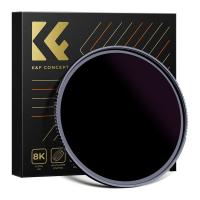
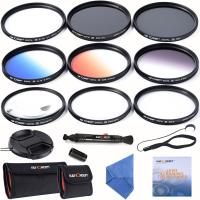
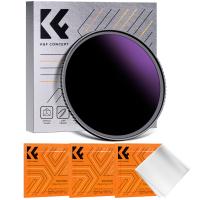
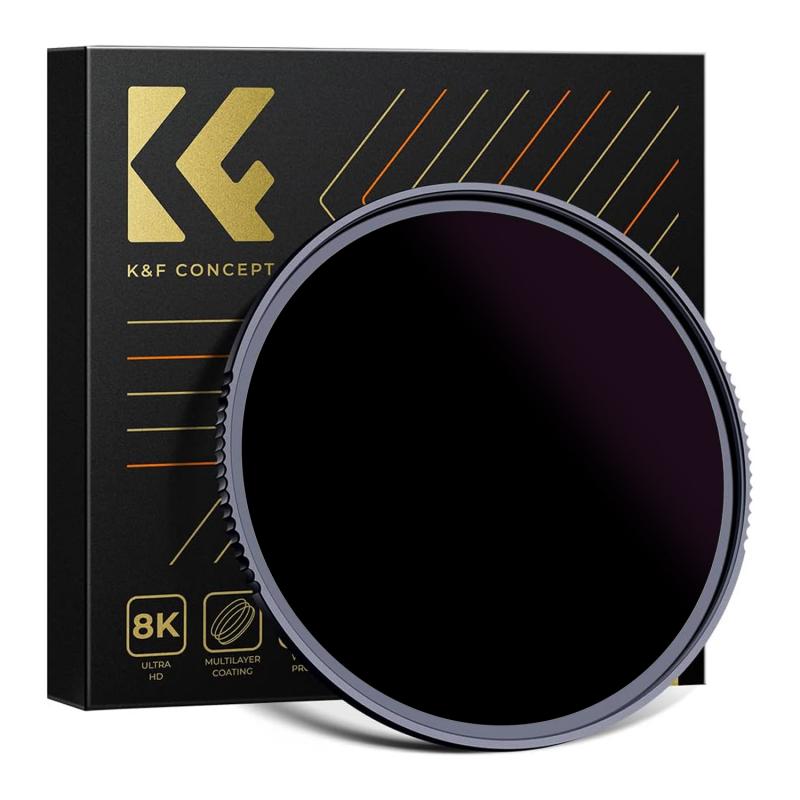
- K&F Concept only if the product is specifically a certified solar filter, not just a dark ND filter
Camera stores can also be a good option, especially larger stores that serve professional photographers. The advantage is that they often list filter thread sizes clearly, and returns are usually easier if you ordered the wrong size. The downside is that some camera shops mainly carry neutral density filters, which are not automatically safe for direct solar photography.
If you shop on Amazon, eBay, Walmart Marketplace, AliExpress, or similar platforms, be much more careful. The marketplace itself is not the issue; the seller is. Buy only if the listing gives clear specifications, shows the actual brand and model, and preferably ships from the brand or an authorized retailer. During eclipse seasons, these marketplaces fill up with cheap listings that look convincing but give no useful safety information.
What to look for before buying
A proper camera solar filter should clearly state that it is made for direct solar viewing or solar photography. Many safe filters reference ISO 12312-2, which is the standard commonly associated with solar viewing products. For camera use, you may also see optical density ratings.
For photography, the common safe types are:
- White-light solar film filters
- Glass solar filters
- Dedicated front-mounted solar filters
- Solar filter sheets used to make a secure front filter holder
The filter must go on the front of the lens, before sunlight enters the optics. This matters. If you put a strong filter behind the lens, or use only a rear drop-in filter on a long telephoto, concentrated sunlight may already be heating internal parts of the lens or camera. For direct solar photography, front-mounted is the normal safe setup.
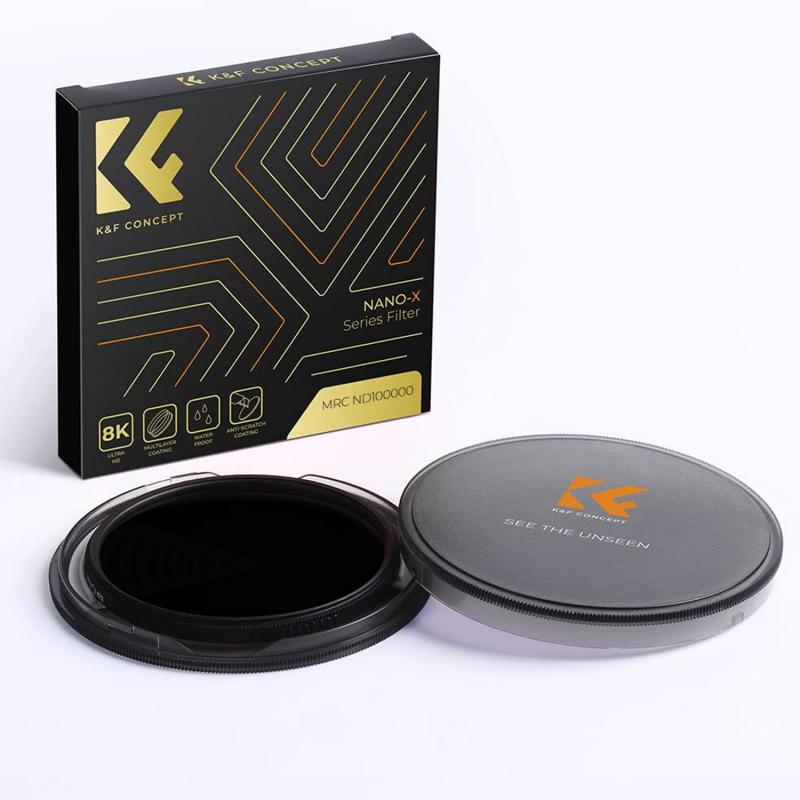
A normal ND filter is not a replacement. Even very strong ND filters may not block infrared and ultraviolet enough for safe use. Stacking several ND filters is also not a good shortcut. It may make the sun look dimmer while still allowing harmful invisible radiation through.
Choosing the right size
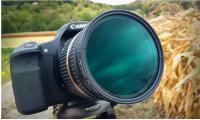
Most camera solar filters are bought by lens diameter, not camera model. Check the front of your lens for a marking such as “ø77mm,” “ø67mm,” or “ø82mm.” That number is the filter thread size.
If your lens has front filter threads, you can buy a threaded solar filter in that exact size. This is tidy and secure, especially for shorter lenses and moderate telephotos.
For larger telephoto lenses, spotting scopes, or lenses without standard threads, many people use slip-on solar filters. These fit over the outside diameter of the lens hood or front barrel. Measure carefully. The outside diameter is not the same as the filter thread size.
A practical trick: if you own several lenses, buy a solar filter for your largest thread size and use step-up rings for smaller lenses. For example, if your largest lens is 82mm, an 82mm solar filter plus step-up rings can cover 77mm, 72mm, and 67mm lenses. Do not use step-down rings for solar work if they cause vignetting or awkward mounting. You want the filter to sit securely and cover the full front opening.
Film vs glass solar filters
Solar film filters are common because they’re affordable, light, and optically quite good when made by a reputable company. Baader AstroSolar film, for example, is widely respected among solar observers. It often gives a sharp, neutral or slightly cool image, depending on the product version and camera settings.
Glass solar filters feel more durable and are easier to handle in the field. They often give the sun an orange or yellow tone, which many people like for photos. The trade-off is that cheaper glass filters may be less sharp than good solar film, especially with long lenses.
For casual eclipse photos, either can work well if the filter is from a trusted source and fitted properly. For sharper sunspot images with a telephoto lens, good film can be surprisingly hard to beat.
Buying for an eclipse
If you’re shopping before a solar eclipse, buy earlier than you think you need to. The reliable filters sell out first. What remains close to the event is often overpriced, poorly described, or the wrong size.
Don’t wait until the week before and assume you can find a proper filter locally. Many people make that mistake. They end up buying something labeled “eclipse filter” from a seller that appeared overnight, or they settle for a camera ND filter because that’s all the store had left.
If you’re photographing a partial eclipse, annular eclipse, or the partial phases of a total eclipse, the filter stays on the lens. During totality, only if you are in the path of totality and the sun is fully covered, photographers remove the solar filter briefly to photograph the corona. The filter must go back on before totality ends. If that sounds stressful, practice the sequence before the day of the eclipse.
For a first eclipse, I’d rather see someone get a few safe, clean photos than spend the event fumbling with gear and missing the experience.
Red flags when shopping
Skip any filter listing that has vague or suspicious details. Be especially careful with products that:
- Only say “ND100000” but don’t mention solar safety
- Claim to be safe with no standard, brand, or technical information
- Have no real manufacturer name
- Use stock images only
- Have reviews that mention sunglasses, welding glass, or unrelated products
- Are shipped by an unknown seller during eclipse rush periods
- Arrive scratched, wrinkled, loose, or poorly mounted
Also avoid using old solar filters without inspecting them. Film filters can develop pinholes, creases, or edge damage. Hold the filter up to a bright indoor light before mounting it. If you see pinholes, tears, separation, or uneven patches, don’t use it.
Good retailers to check
Depending on where you live, these types of stores are usually better than general marketplaces:
- Astronomy equipment shops
- Telescope retailers
- Professional camera stores
- Outdoor optics retailers
- Brand-direct online stores
- Local camera shops that can special-order reputable brands
In the United States, many photographers check stores such as B&H Photo, Adorama, High Point Scientific, Agena AstroProducts, Astronomics, and OPT-style astronomy retailers when available. In the UK and Europe, look for established telescope and astronomy shops, as well as major camera dealers that carry genuine solar observing products. In Canada, Australia, and other regions, the same rule applies: prioritize specialist optics sellers with real product details and return policies.
Local astronomy clubs can also be surprisingly helpful. Members often know which shops have stock, which brands fit common lenses, and which last-minute products to avoid. Some clubs even run eclipse preparation events where you can see different filters in person.
Don’t forget the way it mounts
A safe filter still needs to stay attached. This is where real-world use gets messy. Wind, lens movement, curious kids, and rushed setup can all knock a loose filter off.
For threaded filters, screw them in fully but don’t overtighten. For slip-on filters, make sure the fit is snug. Many experienced eclipse photographers add a strip of painter’s tape or gaffer tape as a backup. Not over the glass or film, of course — just around the filter housing and lens barrel so the filter cannot fall off unexpectedly.
If you use a homemade holder with certified solar film, build it so it cannot shift or expose part of the lens. Cardboard can work for a small setup if made carefully, but flimsy holders are a bad idea on a windy day. Test it outside before the actual shoot.
What I’d buy for most camera setups
For a regular DSLR or mirrorless camera with a kit zoom or short telephoto, I’d buy a front-mounted threaded solar filter from a reputable brand in the correct filter size. It’s simple, compact, and less likely to fall off than a loose homemade holder.
For a long wildlife lens, I’d consider a well-made slip-on glass or film solar filter that fits the outside diameter of the lens hood or front barrel. Measure twice before ordering.
For someone using multiple lenses, I’d buy one quality solar filter for the largest lens thread and use metal step-up rings. That keeps the kit affordable without relying on questionable bargain filters.
The main thing is not to treat this like buying a normal creative filter. A polarizer, ND filter, UV filter, or dark piece of glass is not the same thing as a solar filter. Buy from a seller that understands solar viewing, choose a filter that clearly states it is made for the sun, and make sure it fits securely before you point your camera upward.