How Long Can A Drone Battery Last?
Flight Time per Charge
Drone batteries' longevity is measured in both flight time per charge and the total number of charge cycles they can endure before significant degradation.
- Consumer drones typically offer flight times ranging from 15 to 30 minutes.
- High-end consumer and professional drones can extend this to 45 minutes to an hour.
- Specialized industrial drones, using advanced battery technologies and optimized designs, can achieve flight times exceeding 2 hours.
The average flight time of drones is between 20-30 minutes.
Consumer drones can endure a flight time of 20-45 minutes, and professional drones have the endurance to stay airborne for 1-2 hours or more.
- Toy drones
- 5 – 10 minutes
- Consumer models
- 30 – 47 minutes
- Industrial UAVs
- 60+ minutes
For those with 5” quads running on 6s batteries, how long does it take to deplete your battery?
- 3-5 minutes +/- 2 mins depending on what and how you fly, how big a battery you fly with etc.
- 5” quads are generally not endurance machines.
- 5” freestyle quad with 2207s on 6s, with an 1100-1400 mah pack. quad/battery/gopro altogether around 775g. four or five minutes of awesome at a time.
- 6s 1400 mah on 5". 3 to 6 minutes depending.
Battery Capacity and Flight Duration
A drone battery is a crucial component that powers unmanned aerial vehicles (UAVs), enabling them to fly, perform tasks, and return safely.
Most modern drones use lithium polymer (LiPo) batteries due to their high energy density, lightweight, and ability to deliver high discharge rates necessary for various drone operations.
Other types include lithium-ion (Li-ion) batteries, which offer higher energy densities but are typically heavier, making them less common in smaller consumer drones but more prevalent in industrial applications.
- Battery capacity: measured in mAh, higher capacity batteries store more energy, providing longer flight times.
- Drone weight: heavier drones require more power to stay aloft.
- Payload, such as cameras or sensors, also affects flight time.
- Battery health: older batteries or those that have been improperly maintained degrade and lose capacity, reducing flight times.
- Propulsion efficiency: the design of the motors and propellers affects how efficiently the drone uses power.
For the longest single flight time, batteries with higher capacity (measured in milliampere-hours, mAh) are preferred.
For instance, batteries in the range of 10,000mAh to 30,000mAh are commonly used in professional and industrial drones to maximize flight duration.
However, such batteries are usually heavier and larger, impacting the drone's design and payload capacity.
The simplest rule in drone battery spec is that capacity — measured in milliampere-hours — correlates directly with flight time.
A three-thousand-mAh pack will typically deliver more airtime than a two-thousand-mAh pack in the same drone.
What the spec sheet does not always make explicit is that larger packs weigh more, and the additional mass raises hover power consumption.
Flight Conditions and Power Draw
Several factors influence how long a drone can stay airborne:
- Flight conditions: wind, temperature, and altitude impact battery performance.
- Cold weather can reduce battery efficiency, while high altitudes require more power due to thinner air.
- Flight speed and maneuvers: aggressive flying, high speeds, and rapid maneuvers drain the battery faster than steady, level flight.
- Wind is usually the largest.
- Cold is the second.
- Payload weight from an added sensor or a landing-pad weight counts too, as does recording in 4K versus 1080p.
- Strong wind (15+ mph)
- Higher motor output to hold position
- Cold (below 10°C)
- Slower LiPo chemistry, higher voltage sag
- Aggressive flying
- High current draw for manoeuvres
- Additional payload
- Increased lift requirement
A drone’s hover time represents the maximum duration a drone can stay airborne in zero-wind conditions, whereas real-world flight time takes into account the wind, maneuvering, and sensor power draw.
The manufacturer’s claims are the maximum advertised flight durations of drone companies, measured under no wind and no payload.
Real-world battery life is shorter due to reasons like constant micro-adjustments to flight controllers to counteract gravity and drag.
On average, six to eight minutes is how long it takes to spray out a tank – and the battery will last longer than that.
Flight times per battery charge vary depending on battery and ambient temperature, payload weight, wind and how quickly the drone empties its payload.
With each of our drones, one battery charge can last two tank loads when spraying at a 2+ gallons per acre (GPA) rate.
However, this factor depends ultimately on field geometry; with the average battery life lasting around 8-12 minutes.

Calculating Flight Time
Calculating drone flight time involves understanding the drone's power consumption and the battery's capacity.
- Determine battery capacity (C): measured in mAh (milliampere-hours). For example, a 5,000mAh battery.
- Convert capacity to ampere-hours (Ah): divide by 1,000. (5,000mAh / 1,000 = 5Ah)
- Find average current draw (I): this is the average power consumption of the drone, measured in amperes (A). For instance, if a drone consumes 20A on average.
- Calculate flight time (T): use the formula T = C / I. (5Ah / 20A = 0.25 hours or 15 minutes)
This calculation provides an estimate.
Real-world flight time can vary based on the factors mentioned earlier.
Calculating a drone’s battery life starts with the drone flight time formula.
The battery life calculation formula is a mathematical estimate that is defined by dividing a battery’s total capacity in watt-hours (Wh) by the aircraft’s average drone power draw in watts (W), then multiplying by 60 for minutes.
- Capacity tells you how much charge the pack can hold.
- It is listed in mAh) and Wh.
- To convert, multiply amp-hours by nominal voltage.
- Pack energy density (Wh/kg or Wh/l) indicates energy storage per unit weight or volume.
- Lower internal resistance helps the pack keep its voltage under load.
Drone power draw refers to how the motors and electronics consume the total current (amps) or power (watts) during flight operations.
Charge Cycles and Charging Time
The lifespan of a drone battery in terms of charge cycles varies.
- LiPo batteries usually last between 300-500 cycles before noticeable capacity loss.
- Proper battery management, including avoiding deep discharges and extreme temperatures, can help maximize the lifespan of both battery types.
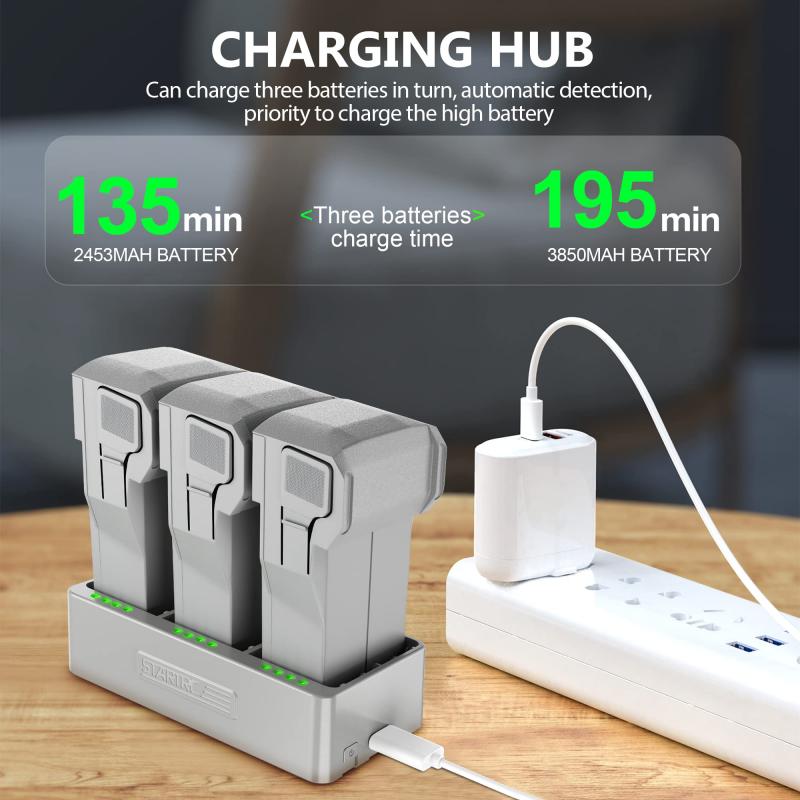
- Charging times for batteries for drones vary by brand, typically taking 1 hour to 3 hours.
- It’s advisable not to deplete batteries for drones below 20% to lengthen their life.
- Also, using chargers with appropriate wattage assures efficient charging times.
While each agras spray drone contains a different liquid and granular tank size and offers different acres per hour rates, kit says the DJI Agras batteries are rated for a thousand charged cycles.
At minimum, I suggest to people that they need a 9,000 running watt generator.
With that capacity, a battery usually charges around eight to nine minutes.
- Long-term storage
- 40–60%
- Before flying
- 100%
- After flying
- Whatever it landed at
- Disposal
- Below 30%
A LiPo pack that has just finished a hard flight will be warm to the touch.
That warmth is normal — it is the energy the pack has just discharged — but it is also a sign that the cells need a fifteen to twenty minute cool-down before going back on the charger.
Charging a hot pack accelerates ageing and pushes cycle count down faster than any other common habit.
Longer Flight Applications
Certain applications inherently demand longer flight times:
- Surveying and mapping: large areas need to be covered, requiring extended flight times to minimize downtime for battery changes.
- Agricultural monitoring: precision agriculture benefits from drones that can monitor large fields without frequent landings.
- Search and rescue: extended flight times increase the chances of locating individuals and provide more time for detailed area scans.
- Environmental monitoring: drones used for wildlife tracking, pollution monitoring, or weather observation often operate in remote areas, where extended flight times are critical.
- Infrastructure inspection: long flight times allow for comprehensive inspections of pipelines, power lines, and other infrastructure without frequent interruptions.
- Logistics and delivery: delivery drones need to maximize their flight time to cover larger distances or multiple deliveries on a single charge.
The drone with the longest battery life is often found within the industrial or commercial sector.
However, custom-built drones for specific applications, like long-range surveying or environmental monitoring, can be equipped with larger, high-capacity batteries or hybrid power systems (combining fuel cells and batteries) to achieve flight times well over an hour, sometimes exceeding several hours in optimal conditions.
Fixed-wing drones use their wings for lift; meanwhile, multirotor drones rely on constant motor thrust.
Although a multirotor can offer more agility for 51 minutes, the fixed-wing drone can fly for up to 480 minutes.
These fixed-wing drones can exceed 2 hours of flight time thanks to rigid wings and aerodynamic efficiency.