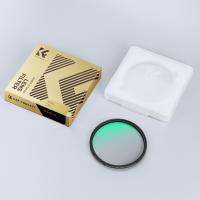
What Are Camera Lens Filters Used For?
What are lens filters and how do they work?
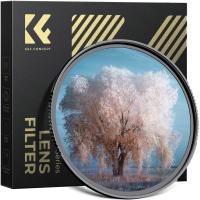
lens filters are transparent or semi-transparent pieces of glass or resin that attach to the front of camera lenses to modify or enhance the captured image. they work by filtering certain types or colours of light coming to the camera sensor.
lens filters are transparent or semi-transparent accessories attached to the front (or occasionally the back) of your camera lens. they manage light, lessen reflections, improve color, and shield your lens from dust and scratches.
camera lens filters come in various forms and types serving multiple purposes with the final goal to improve the quality of your images. they can correct or enhance colours, balance exposure, remove unwanted reflections from the water, create motion blur, etc.
filters in photography – sheets of glass or resin attach to your camera lens – can serve different purposes for photographers. they can be indispensable for capturing scenery in extremely difficult lighting conditions, they can enhance colors and reduce reflections, and they can simply protect lenses.
Why photographers use lens filters
- photographers use these little pieces of glass for a multitude of reasons, but the most common use for photo filters is managing tricky lighting conditions when shooting.
- filters help minimize glare and reflections, enhance colors, reduce light coming into the lens, and more.
- each lens filter serves a specific purpose, as each one is built to deliver a specific effect that can help enhance the final look of an image.
- filters improve light control and reduce post-editing hassles, allowing you to capture the scene as you see it.
- to shield lenses from moisture, dust, and scratches
- to lessen reflections and glare from metallic, glass, or water surfaces
- to deepen blue tones and improve sky contrast
- to regulate exposure in long exposure or bright daylight photos
- to prevent digital noise from excessive editing in order to maintain image sharpness
- while some of the effects created by using camera lens filters can be reproduced digitally in post-processing, many of them cannot be replicated digitally (for example, the effects of polarizing filters).
- overall, lens filters help to overcome challenges before you even get to editing, saving the image quality.
Forms of camera filters
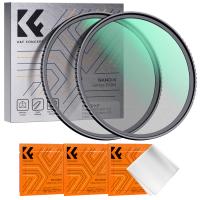
- screw-in circular lens filters
- screw-in circular filters are the most commonly used type of camera lens filters in photography. these filters are very simple to use: they can be screwed directly onto the front of the camera lens without requiring any tools.
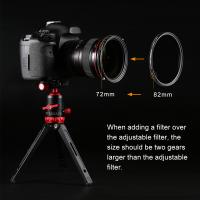
- screw-in filters come in various sizes to match the different lens sizes. you can still attach one filter to a lens of different sizes using an adapter ring.
- note: some wide-angle lenses may experience compatibility issues, such as vignetting when using certain sizes of screw-in filters or combining several screw-in filters.
- square and rectangular camera filters
- square and rectangular filters are used with filter holder systems. the main advantage of this camera lens filter type is the precise control of the filter placement and effect.
- square and rectangular filters are compatible with a wide range of lenses, being an adaptable filtration system.
- additionally, these filters minimise the risk of vignetting, even with wide-angle lenses.
- clip-in lens filters
- clip-in filters are a type of lens filter that is designed to be inserted directly into the camera body, typically behind the lens mount.
- clip-in filters don’t impose the risk of vignetting, as they sit behind the lens and do not obstruct the optical path.
UV and clear filters
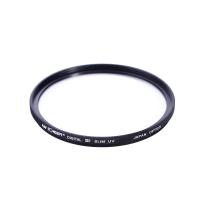
- uv filters
- the original purpose of a uv (ultraviolet) filter was to block uv light, which could cause hazy or bluish casts in film-based photography, particularly near water or at high elevations.
- uv filters are still widely used for one main reason: lens protection, even though the majority of digital sensors nowadays are less sensitive to uv light.
- they serve as a clear barrier to protect your pricey lens from:
- scratches from unintentional bumps
- fingerprints and dust
- water or salt spray when shooting outdoors
- used for daily shooting as a protective layer
- travel and outdoor photography
- filming in dusty or unpredictable environments
uv filters are probably the type of filter that every photographer has. they are primarily used to protect your camera lens from dust, moisture, and scratches, especially when shooting in outdoor environments.
in the past, uv filters were used to limit the uv light coming to the camera lens, but modern camera lenses have less sensitive sensors and there is no particular need for it.
when to use: when you need to protect the camera lens and don’t use any other filter at the moment.
- clear (protect lens during spfx or stunts, aka optical flat or b-glass)
Polarizing filters
- what is a polarizing filter?
- by blocking out light waves that bounce off non-metallic surfaces like water, glass, or foliage, a polarizing filter helps lessen glare and reflections.
- how polarizing filters work
- in order to selectively block light entering from specific angles, polarizers rotate the filter. this improves the natural colour contrast and helps get rid of annoying glare.
- benefits of polarizing filters
- polarising filters are indispensable tools for reducing glare and reflections from non-metallic surfaces such as water, glass or foliage.
- when light reflects off surfaces, it becomes polarised, and the polarising filter blocks this polarised light removing unwanted reflections.
- polarising filters can be rotated, allowing you to adjust the angle of polarisation and achieve the desired effect.
- increases cloud contrast and darkens the sky
- minimizes reflections in windows and water
- intensifies richer and more colourful hues for photographs
- allows for clearer shots by cutting through atmospheric haze
- additionally, polarising filters are effective for enhancing the blues of the sky and green colours and improving overall image contrast.
- polarizer (kills glare, helps see through glass)
this type of camera lens filter is particularly handy when shooting landscapes, outdoor portraits, or architectural photography, where reflections affect image clarity and colour saturation.
note: polarising filters darken the image by 3 stops, take it into account when shooting.
when to use: for outdoor photography, to remove undesired reflections and enhance colours.
ND filters
- what is an nd filter?
- without changing the color balance, a neutral density filter lowers the amount of light that enters your lens.
- consider it your camera's equivalent of sunglasses, enabling you to take pictures with wider apertures or slower shutter speeds even in bright light.
- how nd filters work
- the entire image is uniformly darkened by nd filters, which vary in strength (measured in stops).
- by doing this, you can manage exposure without significantly altering your camera's settings.
- bright lighting conditions
- neutral density (nd) filters are invaluable for controlling exposure settings in bright lighting conditions, allowing photographers to achieve longer exposure times or wider apertures without overexposing the image.
- as the name suggests, these filters do not alter the image colours.
- nd filters come in different strengths allowing to reduce the light reaching the camera sensor by a specific number of f-stops.
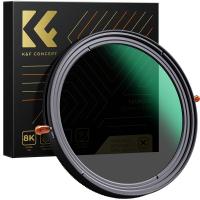
- also, there are variable nd filters that allow regulating by how many f-stops you reduce the incoming light.
- nd filters (neutral density. darkens image. sunglasses for your camera).
- shooting outside in the sun, and don't want your lens at a t22? you need nd.
- achieve motion blur (e.g., silky waterfalls, ocean waves)
- use wide apertures in daylight for shallow depth of field
- prevent overexposure in bright environments
- reduce light for video shoots with consistent shutter speed
- landscape photography
- long-exposure cityscapes
- shooting wide open during golden hour
- videography in direct sunlight
they are commonly used in landscape photography to blur motion in waterfalls or rivers, capture long-exposure cityscapes, or achieve shallow depth of field in bright outdoor conditions.
when to use: in bright outdoor conditions.
ND filter strengths
- nd2: reduces light by 1 stop (50% light reduction)
- nd4: 2 stops (25% light)
- nd8: 3 stops (12.5% light)
- nd16: 4 stops (6.25% light)
some nd filters are variable, allowing you to adjust the strength by rotating the filter, which is ideal for videographers or fast-changing light conditions.
Graduated neutral density filters
- graduated neutral density filters
- graduated neutral density (gnd) filters have a gradient that transitions from transparent to grey across the glass.
- they are commonly used in landscape photography to darken the brighter areas of the image, such as the sky, while maintaining proper exposure in the darker areas, such as the foreground.
- gnd filters are particularly useful for capturing dramatic sunrise or sunset scenes, where the sky is much brighter than the landscape below.
- nd grads (graduated filter, clear on one side, nd on the other, with a blend in the middle. use to darken just the top or bottom or side of the frame.
- soft gnd filters: smooth transition between clear and dark parts of the filter. ideal for scenes with subtle changes in brightness, such as landscapes with hills.
- medium gnd filters: moderate transition between clear and dark parts of the filter. suitable for landscapes with distinct horizon lines or buildings against a bright sky.
- hard gnd filters: the transition between the dark and clear portions of the filter is abrupt. best used for scenes with strong contrasts in brightness, such as seascapes with a clear horizon.
- reverse gnd filters: darkest part of the filter is in the middle. specifically designed for capturing sunrise or sunset scenes.
- when to use: for landscapes with significant variations in brightness.
Color filters and color correction filters
- colour filters for camera lens
- colour filters are used to modify the colour balance of images, adding creative effects or correcting colour casts.
- with the help of this camera lens filter type, you can enhance skin tones, correct colour temperature, or create some surreal effects.
- nowadays, colour filters can be replicated digitally in a lot of cases.
- nevertheless, they are still used in the black in white photography to manipulate tonal contrast and add mood to the photos.
- for example, a red filter darkens blue skies and enhances cloud contrast, creating dramatic landscapes.
- color correction filters (like an 85, 81ef, or 80a. mostly dead on digital.)
- color filters (like red or blue. have interesting effects when shooting black and white)
- fun colors (tobacco, coral, antique suede, etc. mostly dead in favor of post grading)
- color grads (sunset grad, skyfire grad, twilight grad)
another field of their application is underwater photography. colour filters can help restore natural colour balance and enhance the vibrancy of underwater scenes.
when to use: black and white, underwater photography.
Aesthetic and special effect filters
- diffusion (softens image, makes it pretty. black promist, hollywood black magic, classic soft, etc.)
- contrast filters (lowcon, ultracon)
- effects filters (smoque, double fog)
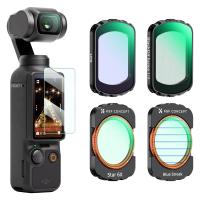
- blue streak filters
- star filters
- bethke filters
- and many more.
special effect filters are the ones that let your creativity rule. with their help, you can add artistic elements to your photos and get some interesting effects.
- infrared filter
- black mist filter
- starburst filter
- astro neutral filter: reduces light pollution in astrophotography, allowing to capture clear, detailed images of starry night skies.
Close-up filters and materials
- diopters (technically lenses, not filters. let you focus closer for inserts and such)
lens filters are typically made of high-quality optical glass or resin. while resin filters are cheaper, they might not have the same image clarity as the filters made of optical glass.
modern optical glass filters do not degrade image quality and are made in a lot of cases of tempered glass that is shockproof.
some filters may also feature multi-coating to reduce reflections and improve light transmission, enhancing overall performance.