What Size Eyepiece For Telescope?
Eyepieces determine the magnification and field of view of a telescope. While a telescope collects and focuses light, the eyepiece creates a virtual image that your eye can actually focus on. Without an eyepiece, placing your eye at the focal point of a telescope does not produce an image, because your eye is also an optical system that cannot focus on a real image such as that created by a telescope.
How Magnification Works with Eyepiece Focal Length
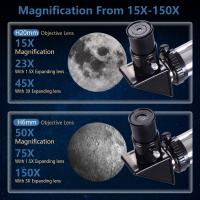
The most important eyepiece characteristic is focal length — the number in millimeters written on the side of every eyepiece. Magnification is determined simply by dividing the focal length of the telescope by the focal length of the eyepiece.
- A smaller focal length number on an eyepiece gives higher magnification. A 10mm eyepiece provides twice as much magnification as a 20mm eyepiece.
- The same eyepiece gives different magnifications on different scopes. A 10mm eyepiece would be low power on a short-focal-length scope but high power on a long-focal-length scope.
- A typical eyepiece collection includes 3 eyepieces: one low power, one medium power, and one high power. For most scopes the normal range might be from 50x to 250x.
- Increasing the magnification makes the image larger, but the image gets dimmer and the field of view gets smaller.
To calculate minimum magnification, divide the telescope aperture in mm by 7. For example, a 200mm aperture telescope has a minimum magnification of 28x. The optimum magnification is calculated as aperture divided by 0.8. A 200mm telescope therefore has a useful magnification of 285x. The maximum magnification rule of thumb is lens aperture multiplied by 2, giving a 200mm telescope a maximum of 400x — though this rarely works in practice since the image becomes dark and atmospheric seeing must be perfect.
Exit Pupil and Choosing Eyepieces by Object Type
The exit pupil is the bundle of light that enters the eye from the eyepiece. It is calculated as: exit pupil = telescope aperture (mm) ÷ magnification, or exit pupil = eyepiece focal length ÷ telescope focal ratio. Seven millimeters is exactly the maximum aperture of the human eye's pupil — with a larger exit pupil, the extra light is lost.
- Large nebulae, open star clusters, galaxies
- Small magnifications with an exit pupil of 7–6mm are most suitable. Low magnifications offer a large field of view.
- Open star clusters and galaxies (closer views)
- Best observed between exit pupils of 3.5mm and 1.5mm.
- Globular clusters
- Can use a higher magnification with an exit pupil between 1.5mm and 1mm.
- Planets and planetary nebulae
- Optimum magnification is reached at an exit pupil of 0.7–0.8mm. A 133x starting point is typical for planetary observing.
- Double stars
- Magnification can be set very high, with an exit pupil between 0.7mm and 0.5mm.
Eyepiece Barrel Sizes
Astronomical eyepieces come in standardized barrel sizes. There are three standard sizes: 0.965", 1.25", and 2".
- 1.25" eyepieces — The most common size, available in almost all telescopes. Used for medium and high magnifications and useful when observing lunar craters, planets, or globular clusters. Accessories such as barlow lenses and filters are designed to thread into the barrel of these eyepieces. Good 1.25" eyepieces typically cost $40–$200.
- 2" eyepieces — The larger standard size. These are wide-field, low-power eyepieces offering a wonderful overview at small magnifications, suitable for searching for objects, observing large objects, or enjoying a wide field of view. Telescopes with a diameter of 150–200mm or more typically have a focuser that accepts 2" eyepieces. 2" eyepieces typically cost $200–$400, with some of the largest and highest quality costing around $600.
- 0.965" eyepieces — The size to avoid. This is the standard size for "department store" telescopes. Standard accessories such as barlow lenses and filters are not normally available for these eyepieces, and 0.965" eyepieces are rarely sold separately. The difference between a scope with 1.25" eyepieces and one with 0.965" eyepieces is usually the difference between a scope that shows you the wonders of the universe and one that ends up in the closet collecting dust.
Eyepiece Design Types
The three most common types of eyepieces are Plössls, wide angle eyepieces, and zoom eyepieces.
- Plössl
- The most common type of eyepiece, consisting of four lenses arranged in two back-to-back achromatic doublets, keeping chromatic aberration and color fringing to a minimum. Ideal for viewing anything from planets to deep sky objects. The apparent field of view is right around 50°. Short eye relief is common with this type, which may be problematic for eyeglass wearers. Many telescopes come standard with at least one Plössl.
- Wide Angle
- Offers a more immersive experience thanks to a large apparent field of view. Anything wider than 80° is typically classified as wide angle, though many models with 68° and 72° AFOV have also been designated as wide angle. Some wide angle eyepieces now offer AFOVs of up to 120°. These eyepieces are typically designed with five internal lenses and are excellent for viewing large deep space objects.
- Zoom
- Designed with multiple focal lengths, offering varying magnifications with one system. Useful when you need to quickly reduce and increase magnification repeatedly, and beneficial for outreach use and terrestrial observing. An important thing to remember: their field of view and eye relief will shrink as you move from high to low focal length. It may also be possible that the focal lengths offered with a zoom eyepiece do not cover the entire range of magnifications your telescope can support.
Eye Relief and Optical Quality
Eye relief is the distance from the eyepiece to the observer's eye. The shorter this distance, the more difficult it can be to observe. If the observer must wear eyeglasses, short-eye-relief eyepieces can be very difficult or impossible to use. Long-focal-length eyepieces (usually low power) inherently have long eye relief. Short-focal-length eyepieces (usually high power) must be specially designed to make them easier to use. An eye relief of at least 10mm is recommended for all viewers, and at least 15–20mm for those who wear glasses.
As with any optical system, the quality of views is reliant on the lowest quality of glass utilized within the optical train. Premium optical elements perform better at correcting incoming light and ensuring maximum light throughput for brighter, higher contrast views. Specialized coatings also play a significant role — they ensure the utmost light transmission and offer protective abilities against scratches, dirt, and moisture. Many premium eyepieces also feature blackened lens edges, where the matte black paint around the lenses minimizes internal reflections, bringing sharpness and contrast to their peak.
Recommended Focal Length Sequences for an 8" Dobsonian
When selecting a focal length sequence for deep sky viewing, a good strategy is to double the view brightness at each progression. This is accomplished by multiplying a focal length by the square root of 2, or about 1.41. Starting with a 12mm eyepiece producing a 2mm exit pupil, a practical sequence for deep sky would be:
- 12mm
- 18mm
- 25mm
- 30–32mm
Each of those represents a doubling of view brightness over the previous focal length. A 2mm exit pupil tends to be a good balance of view brightness and magnification for most deep sky targets.
For planetary viewing, since seeing conditions can vary so much, reasonably tight magnification spacing is preferred — somewhere between 40–60x jumps, starting at about 120x–150x. In a scope with 1200mm focal length, the magnifications of 9mm, 7mm, and 5mm eyepieces look like this: 1200/9 = 133x; 1200/7 = 171x (+38x); 1200/5 = 240x (+69x). A 9mm eyepiece gets you 133x, which is the starting point for planetary observing. From there, adding 7mm and 5mm focal lengths covers the planetary range with appropriate magnification jumps.
When getting started, aim for around 3 to 4 quality eyepieces — one with low magnification, one with medium, and one slightly higher magnification. It is far better to choose three very good eyepieces that give sharp images and good contrast than seven mediocre ones. Invest at least fifty euros or more per eyepiece to ensure a quality observing experience.