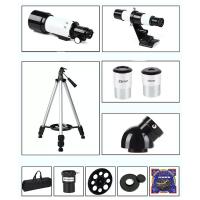
What Is An Optical Telescope Used For?
Collect Light from Distant Objects
optical telescopes are instruments designed to collect light from distant objects so that images may be produced or the light analyzed by a detector.
optical telescopes are specialized instruments designed to gather light from distant celestial objects, enabling the production of images or analysis of light through various detectors.
a telescope is a device that permits detailed inspection of a distant object; originally, an instrument that used lenses or mirrors to collect large quantities of light and focus an image from a tiny area.
to help see objects in space, a device called a telescope was invented. a telescope is a tool that makes far off things look up-close and bright.
early telescopes focused light using pieces of curved, clear glass, called lenses. however, most telescopes today use curved mirrors to gather light from the night sky. the shape of the mirror or lens in a telescope concentrates light. that light is what we see when we look into a telescope.
astronomy is the study of everything that exists beyond the earth. but it is really about the study of light. whether you are doing research, or just gazing up at the night sky, everything that you see is in the form of light.
but the human eye cannot see fine details of dim or distant objects, so much of the universe remained hidden.
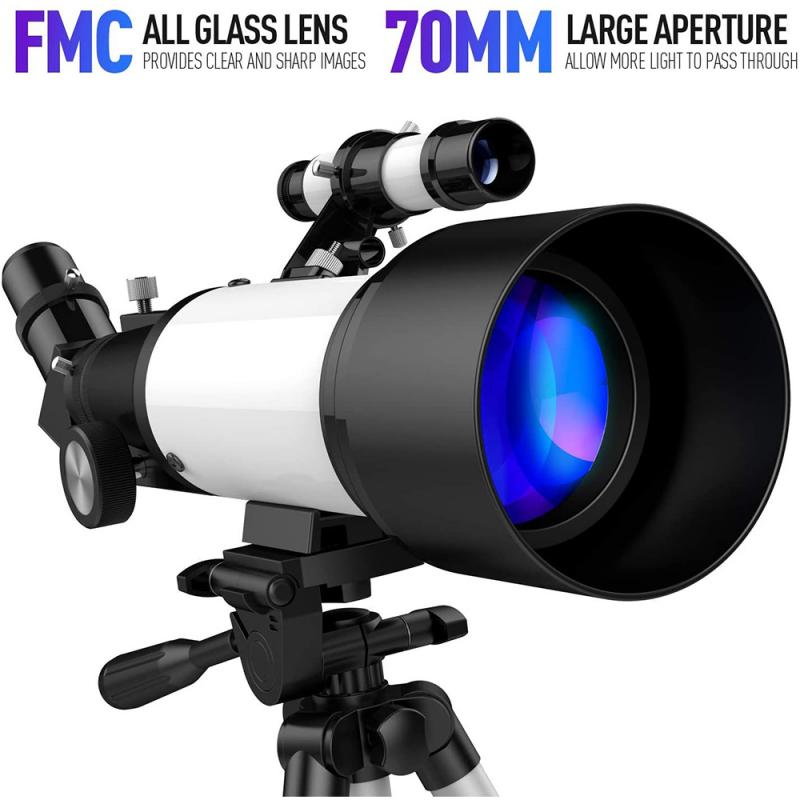
Refraction or Reflection
- there are two primary types of optical telescopes: refractor telescopes, which utilize lenses to bend and focus light, and reflector telescopes, which employ curved mirrors for the same purpose.
- refractor telescope: a telescope that works principally by using lenses to focus light.
- reflector telescope: a telescope that works principally by using curved mirrors to focus light.
- in refraction, light is bent as it passes through a material; the degree to which it is bent depends on the angle at which the light strikes the surface and the material’s own index of refraction.
- if the material’s surfaces are curved to match a spherical surface, then the incident light can be brought to a point known as the lens’s focus.
- reflectors are based on the simple law of the angle of incidence equaling the angle of reflection.
nevertheless, the index of refraction varies with the wavelength of light (longer wavelengths are bent less than short wavelengths), which results in the projected image having its colors smeared (chromatic aberration).
this can be compensated for by using multiple sets of lenses with different indices of refraction and varying focal lengths to compensate for the effect.
the laws of reflection work at any wavelength and without regard to color (that is, there is no chromatic aberration).
reflectors suffer from a different problem called “coma,” which smears an image into a comet shape pointing away from the focus.
coma is greatest the farther one moves from the focus and can be corrected by complex optical systems.
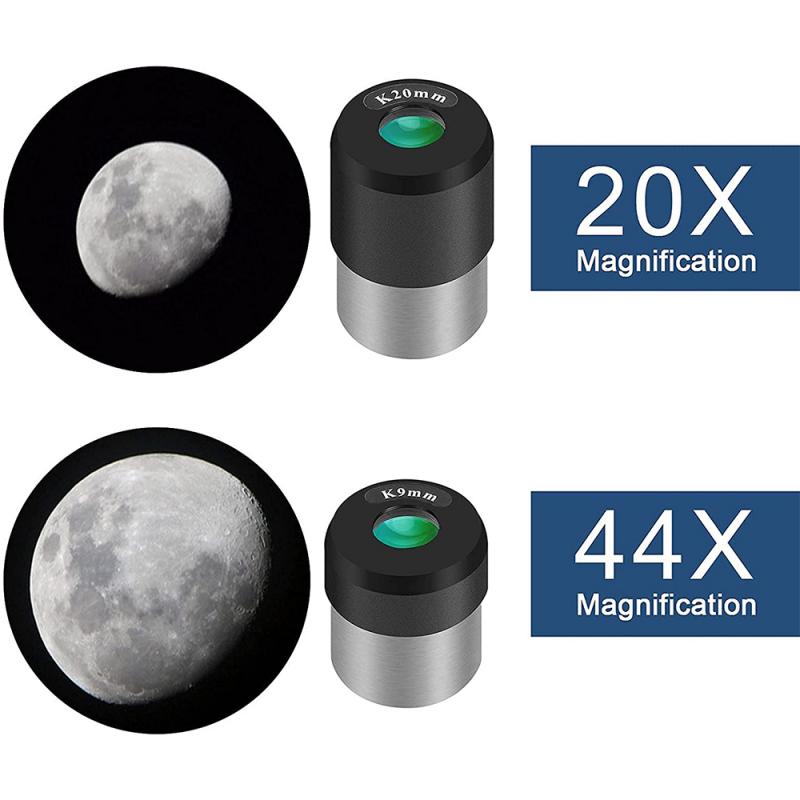
Refractor and Reflector Designs
- refractor telescopes are useful but have a number of limitations, including a maximum aperture of 1 meter (3.3 feet), because at that point, deformation caused by gravity becomes noticeable.
- further, glass will absorb portions of the incoming light so that its spectral range is limited.
- reflector telescopes have proved to be far more versatile and powerful for astronomy.
- if the mirror is shaped to match the curve from a conic section (such as a parabola), then the light from a source at infinity will be brought to a focus regardless of where on the mirror it strikes.
- light from a source slightly removed from the centerline of the telescope (off axis) will be focused at a point proportionally distant from the center, and an image will be formed.
- few reflector telescopes work in the “prime focus mode,” where a camera or detector is placed directly at the focal plane, because of the distortions that normally result.
the most widely used reflector telescope types are newtonian and cassegrain.
the newtonian reflector is the original reflector developed by sir isaac newton. it has a parabolic primary mirror and a flat secondary mirror at the focus of the primary.
the secondary mirror reflects light at a right angle to an eyepiece (normally refractive) or instrument at the side of the telescope barrel.
the cassegrain telescope and its variants have become the most widely used in professional astronomy because they greatly reduce obstructions in the field of view and allow instruments to be mounted behind the primary mirror for easier servicing.
a hybrid telescope design is the schmidt, which combines elements of reflector and refractor designs.
spherical rather than parabolic primary mirrors are ideal for making wide-field surveys of the sky but suffer from extreme spherical aberration.
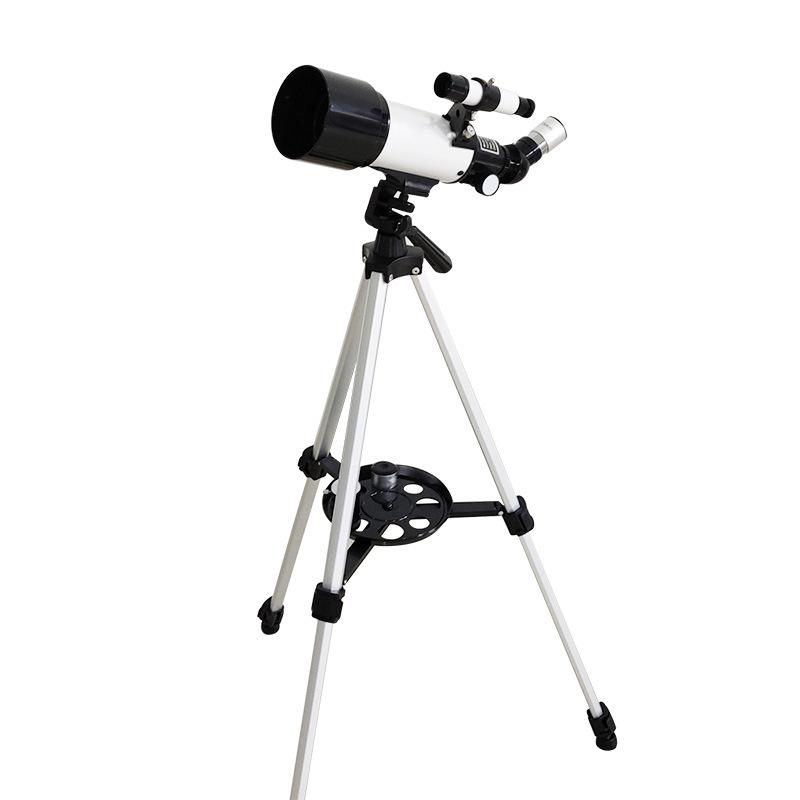
Observing the Universe
- optical reflector telescopes
- optical reflector telescopes have served as the primary instruments through which much of the universe has been explored.
- optical astronomy
- optical astronomy is conducted from the surface of the earth and from satellites in orbit, where the blurring and absorptive effects of the atmosphere are largely eliminated.
- space telescope
- space telescope: generically, any astronomical telescope that operates in space rather than on the earth.
- spectroscopy
- spectroscopy: measurement of the intensity of light at specific wavelengths (energy levels) in the spectrum.
- resolution
- resolution: a measure of the level of detail that a telescope can “see” in a particular scene; resolution depends on the design of the telescope and on “seeing” conditions between it and the object.
most space-based astronomy has involved those regions of the spectrum that are obscured by the atmosphere.
an observatory is a place where people watch the sky and study stars, planets, and other space objects. most modern observatories use reflector telescopes. these telescopes are big and let in a lot of light. at this size, using lenses would be too heavy and hard to handle, so reflectors work much better.
the dimmest objects in the universe do not give us a lot of light to work with. this is why we need telescopes with big apertures so that we can even see them!
it can actually help to use low magnification for these types of objects. objects, such as star clusters and galaxies can be too large to 'zoom in' on. the andromeda galaxy, for example, appears to be larger than the full moon in the night sky!
Atmosphere and Resolution
- the atmosphere poses additional limitations in that the resolution possible from the ground is limited to about 1 arc second.
- air has its own index of refraction, which can be enhanced where cold layers meet warm layers of air.
- the atmosphere thus acts as a variable lens that misshapes starlight (causing stars to twinkle) even before it enters a telescope.
- as a result, the best “seeing” that can normally be achieved on the ground is about 1 arc second and can be achieved with a telescope aperture of 40 to 50 centimeters (15.7 to 19.7 inches).
- telescopes larger than 50 centimeters (19.7 inches) may see fainter objects, but not to enhance resolution (or, stated differently, magnification).
- isolated, mountaintop locations can provide occasional seeing of 0.4 arc second or better, but this is only a partial solution.
speckle interferometry, a computational technique, has been applied to enhance the resolution from ground-based telescopes.
this approach treats the atmosphere as the first optical element in the telescope.
in adaptive optics using laser guide stars, a laser is beamed into the atmosphere and the return signal is analyzed to determine how much the perfect spot beam has been distorted.
an alternate technique is to measure distortion in a star’s image.
from this technique, a corrective algorithm is derived and used by a computer to adjust the deformable mirror of the telescope or to adjust the image from the charge-coupled device (ccd).
Multiple and Segmented Mirrors
- telescopes that use multiple primary mirrors are becoming popular as a means of circumventing size limitations on older designs.
- the advent of advanced computerized control systems in the 1970s raised the possibility of building large telescopes that would not be perfect when finished but could be made so during an observation.
- basically, the concept was to use actuators to adjust the shape of the mirror several times a second in response to changes in the atmosphere.
- in the first, the images from several telescopes are joined to yield the same effect as a larger mirror.
- the alternate design is to fabricate a single primary mirror as a series of segments, which are mounted on a support structure.
- laser rangefinders then measure the position of each mirror and feed that information to computers that calculate how far each must be adjusted to align the collection.
new technology telescopes, a generic term applied in the late 1970s, are those that use multiple or segmented mirrors to gain the effect of a single larger observatory.
the multiple mirror telescope (mmt) atop mount hopkins in arizona was the first of the new technology telescopes.
following the success of the mmt, a number of new technology telescope (ntt) designs were suggested, although funding became a major issue.
one of the first large segmented-mirror telescopes to be built was the 10-meter (32.8-foot) keck memorial telescope atop mauna kea, hawaii.
instruments on the telescope sense the state of the wavefront entering the telescope and adjust the position and tilt of each mirror to compensate.