How To Adjust A Scope?
Like most new gear, a scope comes with some initial steps to get it up to snuff. Discovering how to adjust a rifle scope — from the lens to the turrets and more — is essential before it's taken on the field. In the world of precision shooting, your ability to dial your optic correctly is a critical skill for making effective hits on your target. When you're shooting past 300 yards, gravity, wind, and environmental conditions all start to play a major role in your bullet's flight. Making an accurate scope adjustment allows you to precisely correct for bullet drop, wind drift, elevation changes, and shot angles.
Know Your Rifle Scope Parts
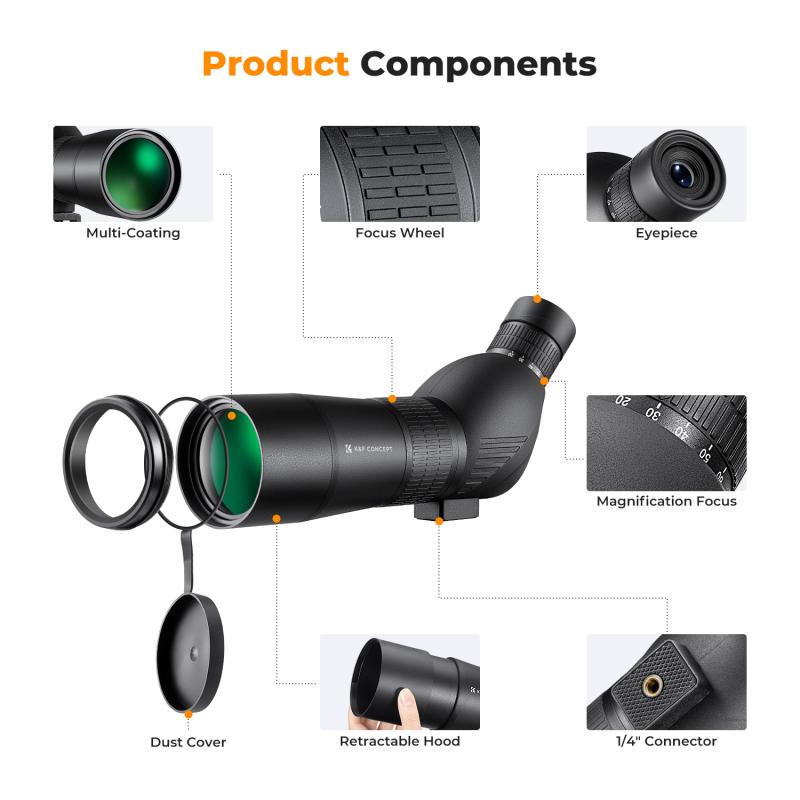
As we break down how to adjust a rifle scope, specific parts will be mentioned. To better understand the steps, it's essential to become familiar with a scope's central components, such as the ocular lens, the magnification adjustment and turrets. Here's what you'll be adjusting and working with:
- Scope Body
- Used to aim, this is the main tube of the scope where the other parts are attached.
- Ocular Lens
- This lens rests in the ocular housing and is closest to the eye when looking through the scope.
- Objective Lens
- On the opposite end of the ocular lens is the objective lens, which faces the target. Typically, and similar to a camera, the objective lens is larger.
- Ocular Housing
- The ocular housing is the "eyepiece" of the rifle scope where the ocular lens rests, along with the ocular focus adjustment.
- Ocular Focus Adjustment
- This focus adjustment is the mechanism used to focus the reticle crosshairs to your eye. The entire ocular focus housing turns on some rifle scopes, whereas others may have only an adjustable outer section around the lens.
- Magnification Adjustment
- Fairly straightforward, this part tweaks the magnification power.
- Turrets
- These knob-like parts are used to fine-tune the elevation and windage of a shot. Jutting out from the scope body, they are exposed and easily accessible, allowing you to adjust while aiming. Sometimes, turrets are capped for protection.
- Reticle
- These are the cross-hairs you use to aim when looking down the scope. A long-range shooting scope is highly detailed, providing references to elevation and windage holds.
- Parallax Adjustment / Target Focus
- This scope part adjusts to align the target image with the reticle's focal plane. This adjustment ensures that the images of the two objects you are looking at do not shift, allowing the target to come into a crisp focus. You can find a turret-like knob called a "side focus" or "side parallax" on high-end scopes. Other times, they're merely found as an outer ring design called an "adjustable objective scope" around the objective lens.
Key Long-Range Shooting Terms
Before diving deeper into making the right scope adjustment, it's important to understand the language of long-range shooting. Here are some fundamental terms every shooter should know:
- D.O.P.E. (Data on Previous Engagements)
- Creating a D.O.P.E. card and keeping it with your rifle helps you reference data you have collected over time to make quick adjustments. Every time you go to the range to practice your long-range shooting, take notes on your rifle's performance to record for your D.O.P.E. card to use later.
- Windage
- Windage is the horizontal adjustments that you can make within your scope to account for wind drift. It may not matter much at shorter distances or during light winds, but its role is magnified in harsh conditions and at longer ranges.
- Elevation
- Elevation accounts for the vertical drop in a bullet's path when shooting. It's the most common adjustment you'll make when shooting at longer ranges. Most shooters can use holdovers for slight elevation changes at closer ranges.
- Ballistic Coefficient (BC)
- The ballistic coefficient is a measure of a bullet's ability to overcome air resistance. A bullet with a higher BC number will generally perform better at longer ranges, since it will cut through the air better with less wind drift and less drop in elevation. You can input the BC of the bullet you are shooting with a ballistic calculator to get more accurate data.
- Muzzle Velocity
- Muzzle velocity measures the speed of the bullet as it leaves the barrel. This measurement is important for calculating the elevation drop in a bullet, and an inconsistent muzzle velocity can leave you guessing on how fast your bullet is dropping. Most ammunition boxes will come with the tested muzzle velocity printed on them, but you can also use tools like a chronograph to measure muzzle velocity out of your particular rifle.
Zeroing: How to Adjust Elevation
It's still a good idea to make sure your elevation is "zeroed" before taking down a deer. To adjust the scope's elevation and move the point of impact (POI) up, you simply turn the scope's elevation turret in the "up" direction. For many scopes, this means rotating the turret counterclockwise. As you turn the turret, listen for a clicking sound. Each click signals an angular measurement known as the Minute of Angle (MOA), often representing one-quarter of an inch per 100 yards. However, be sure to inspect your personal scope to be sure.
The combination of this clicking noise and an exposed turret allows you to make elevation adjustments while peering through the scope and holding position. Just remember the expression "righty tighty, lefty loosey" to help you understand that turning the turret counterclockwise raises the POI elevation, and clockwise lowers the POI.
Sometimes, your turret adjustments can appear to be out of whack, working in reverse of the way they are designed. If this happens, it means you also need to adjust your reticle. When you turn the turret up, the reticle should go down inside the scope, and then you should manually raise or lower the rifle accordingly.
MOA vs. MIL Scopes
Scopes typically use either MOA (Minutes of Angle) or MIL (milliradians) increments for adjustments. Both are widely used. Here is a quick overview of each system:
- MOA Scopes: Inch-based measurements. 1 MOA ≈ 1.047 inches at 100 yards. Scope adjustments are often in ¼ MOA per click increments. Preferred by most recreational shooters and hunters for its standard terminology and ease of understanding.
- MIL Scopes: Metric-based measurements. 1 MIL = 10 centimeters at 100 meters (~3.6 inches at 100 yards). Adjustments are often in 0.1 MIL per click increments. Popular among former military and law enforcement shooters who were trained on MIL scope systems, as well as competitive shooters.
Both systems work effectively, and determining which one to use is ultimately up to personal preference. Once you pick a system you like, continue to use it and stick to it. Make sure that your calculations also match the system you are using to avoid confusion and wasted time.
How to Adjust Windage
Windage adjustments are similar to your scope's elevation adjustments. The key difference is that while elevation is intended for raising and lowering a bullet's impact, windage is meant for adjusting the bullet left to right. As the name implies, the windage adjustment helps combat strong wind conditions that could offset the bullet from the desired target.
Many shooters leave the windage alone, focusing more on the elevation turret. While at great distances, strong winds can push a bullet mid-flight, touching the turret isn't necessary. Instead, many shooters find it more advantageous to simply adjust the rifle itself. One reason is that strong winds can often get squirrely, constantly shifting direction. Changing a turret with each wind gust is much more challenging than ever-so-slightly shifting your rifle with your hands.
The windage turret is often found on the side of the scope body. Like the elevation turret, the windage turret has an easy way to remember how it's designed to be adjusted. Use the mnemonic device: "I don't want to be left out, so I'll be right back." In other words, rotating the windage turret out or away adjusts the scope left, and turning the turret back toward you adjusts the scope right.
How to Adjust Target Focus and Parallax
To better understand parallax, perform this simple at-home demonstration:
- With a raised index finger, extend your left arm in front of you.
- Do the same with the right arm and hand, except align it somewhere between the extended left hand and your eyes. (You should be seeing two fingers, aligned but at different distances.)
- Keeping your fingers steady, move your head from side to side. The shift you notice is what's known as parallax.
Parallax is often caused by moving the rifle barrel's orientation, which results in a shift of the bullet's path. Focusing on the reticle, adjust the target focus. Move the scope's focal point of the image to align with the reticle. When you align both the reticle and the target's image along the same focal plane, it means it's in focus and, therefore, no parallax effect.
Don't confuse the two terms "adjustable objective" and "adjustable parallax," as they mean two different things. An "adjustable parallax" is something you want on a scope. On the other hand, having an "adjustable objective" on an adjustable parallax scope is undesirable. Instead, you should seek out a side-focus/side-parallax knob.
How to Adjust the Eyepiece and Magnification
With all the turrets adjusted, you still need to focus the eyepiece. Sadly, this is one of the most common mistakes even a professional shooter tends to make. Not only do some shooters not know how to tweak the eyepiece correctly, but some don't even know the adjustment option exists. Make sure your scope is set up correctly and focused so you see the reticle crisp and clear. Only when you can see without squinting or straining should you bring the target into the reticle to make it clear and without that double-vision parallax.
For magnification, look for a ring in front of the ocular housing that allows you to adjust the magnification. On adjustable power scopes, you can use this magnification adjustment to change the target image scale, making it larger or smaller. Keep in mind that some rifle scope reticles increase the size proportionate to the target (First Focal Plane). In contrast, other scope reticles stay consistent throughout the magnification (Second Focal Plane):
- First Focal Plane (FFP): The reticle adjusts with the target image. You can use the reticle markings for measurement at any magnification setting. One advantage of the FFP is that it's useful for range estimation using mils. However, the disadvantage is that the reticle can appear overly thick or thin at some magnification ranges. FFP scopes are more ideal for long-range shooters.
- Second Focal Plane (SFP): The reticle does not adjust, only the target image. The reticle is already an appropriate size for aiming. However, this can cause issues when you try to use graduated marks on the reticle at an incorrect magnification power setting. MIL or MOA reticle marks will more than likely only be equal to their true size at full magnification power. In general, an SFP is advantageous, allowing you to see the reticle in low light and low power magnification.
When it comes to magnification adjustments, avoid using the full power constantly. Many shooters tend to aim better at a lower power, taking advantage of less visible movement in the image and spotting your target effortlessly.
Dialing In Long-Range Scope Adjustments
When the time of the shot comes and you need to make a scope adjustment, there are multiple tools that you can use to gather data and dial in your shot with confidence and precision:
- Ballistic Calculator: Having a ballistic calculator with your ammunition and rifle information dialed and ready to go can help you make a quick, accurate adjustment. All you need is the distance to your target.
- Rangefinder: Having a rangefinder is non-negotiable for making accurate long-range shots. They provide near instant feedback of your target's distance for dialing in your scope adjustment.
- Weather Meter: A weather meter is a device that provides a readout of environmental factors like wind speed and relative humidity, helping you make precise adjustments.
- Custom Turrets: While not a necessary addition, some manufacturers can provide custom scope turrets that are dialed to your specific rifle and ammunition load, helping to ensure accurate adjustments.
Once you have your tools ready, making the scope adjustment is a relatively simple process:
- Find the range of your target with a rangefinder, or use your scope reticle if it has range-finding capabilities.
- Measure other environmental factors with your weather meter, or use a weather app for the approximate windspeed at your location.
- Input the distance and other information into your ballistic calculator, and consult your D.O.P.E. card for previous observations.
- Dial your scope adjustment based on your ballistic calculator and/or D.O.P.E. information.
- Squeeze the trigger and observe your shot for any further corrections.
What to Do If Your Scope Runs Out of Adjustment
All riflescopes have a limited amount of internal adjustment that can move the rifle's point-of-impact. The amount of adjustment required to sight in your scope is determined by how well aligned the scope is to the bore of the rifle. If the scope has less adjustment than what is needed to correct for its alignment to the rifle, you will run out of adjustment while trying to zero. When you attempt to make an adjustment, your point-of-impact will not change and/or the dial itself will physically stop turning.
If you are running out of adjustment while zeroing your riflescope, the solution is to improve the physical alignment of the scope to the rifle's bore. There are many ways of doing this:
- Running out of windage: The correction needs to be made with windage adjustable bases or rings. Windage adjustable bases have two windage screws holding the rear ring. By loosening one side and tightening the other, they shift the rear of the scope right or left for gross windage adjustment.
- Running out of elevation up: If your bullet is impacting low and you have dialed your scope all the way up, an inclined base such as a 20 MOA base may lower your point of impact far enough to sight in.
- Running out of elevation down: Many scopes feature a zero-stop or ZeroLock elevation dial that limits travel below the set zero of the firearm. If you encounter this mechanical limit in the downward direction while sighting in, loosen the dial set screws and turn the dial in the up direction 1–2 revolutions, then re-tighten the set screws. This will allow more dial travel in the down direction. Once the desired zero has been achieved, loosen the set screws again, turn the dial until the zero stop or ZeroLock is engaged, then re-tighten the set screws.
Learning how to adjust a rifle scope takes patience. These adjustment steps are more specific to the turrets and pieces directly on the scope body, which takes effort to tweak just right. However, there are a few other adjustments you should make before attaching the scope itself. Before you even consider mounting the scope to the rifle, make sure to choose the suitable fitting along the rifle. For example, you can elevate the height of your scope, its position forward or rearward, as well as level it if needed.