How Accurate Is Dash Cam Speed?
If you are in an accident, how do you show you were not speeding? Modern dash cams do more than just record video. A dash cam that records speed can capture your exact speed, your car's location, and where you have driven. These cameras give you strong proof for insurance or traffic arguments. When someone says you are at fault, your dash cam can be your best support. But how accurate is dash cam speed, and can that data hold up when it matters most?
How Dash Cams Record Speed
A dash cam that records speed uses a built-in GPS module to track your vehicle's movement in real time and calculate accurate driving speed. Your dash cam uses a small, built-in GPS receiver to talk to satellites. As you drive, it finds your exact location several times each second. It calculates your speed by measuring how far you travel between these points, giving you an accurate reading in real-time.
After calculating your speed, your camera adds it directly to your video as a text stamp. This lets you see how fast you were going when you watch the footage. Some cameras also save this data, so you can see your route and speed on a map. Depending on the model, speed data appears in one or both of the following ways:
- Speed overlay: The speed is shown directly on the video as a visual stamp, making it easy to share a clip quickly without extra steps.
- Speed logs / metadata: Speed is saved in a file record or app log, sometimes without showing on the video itself. This format is better for preserving original details and can support a more complete timeline when paired with timestamp and location data.
GPS-based speed logging typically does not require internet or cellular service. It is based on satellite data, not a phone signal. One practical detail matters here: GPS lock. Your dash cam needs to lock onto satellites before it can record stable location and speed data. Some devices lock quickly. Others take longer, especially after a cold start or in areas with blocked sky view.
How Accurate Is GPS Speed on Dash Cam Footage
GPS speed can be accurate enough for everyday documentation, but it is not perfect. Accuracy depends on signal strength and conditions.
- Conditions where GPS speed tends to be more accurate
- Open highways and clear sky view, consistent driving with steady satellite lock, areas without frequent signal obstruction.
- Conditions where GPS speed may be less reliable
- A dash cam that hasn't fully locked onto GPS yet, sudden GPS dropouts where the signal is interrupted, tunnels, dense cities, and weak signal periods.
You might notice that the speed on your dash cam is a little different from the speedometer in your car. This is normal because speedometers in cars are often set to show a speed that is a little faster than what you're really going. Your dash cam uses GPS data, which is usually more accurate. Generally, GPS devices are very accurate, even more so than vehicle speedometers.
Your dash cam needs a clear view of the sky to connect with GPS satellites and work properly. This connection can be blocked by tall buildings, thick trees, or even bad weather. If the signal is weak, your speed reading might not be right, or it might not work at all.
Your dash cam updates your speed at a certain rate, called the refresh rate. High-quality dash cams check your speed several times a second, which gives you a very accurate reading. This means that your camera will be able to accurately record any quick changes in speed, like when you suddenly brake or speed up, that slower devices might miss. Your dash cam might lose its GPS signal from time to time, like when you drive into a tunnel or an underground parking garage. Your dash cam will start recording your speed again as soon as it can see the sky clearly.
Factors That Affect GPS Speed Quality
How well your dash cam records your speed depends a lot on how good it is. Better dash cams have GPS chips that work better and connect to satellites faster.
- Models that cost less might not be able to keep a steady connection, which could mean that the speed they show isn't always right.
- There are far stricter standards for the calibration of speed cameras and the lidar systems utilized by police than there are for the GPS speed calculation of a dash cam.
- GPS isn't that accurate for calculating speed. It depends on the refresh rate of the signal and topography of the area you were in.
- It is entirely possible that some devices are doing a distance calculation for speed, which is absolutely prone to error, because it can depend on a variety of factors related to the accuracy of the GPS unit.
- The accuracy of the average dash cam is not better than the laser speed reader used by law enforcement.
One method that can provide very accurate speed verification independently of the GPS speed display is to use the video timestamp. If you have a minute of nearly constant speed in your footage, you can go to Google Maps, use the measure distance function to measure the distance traveled in miles, multiply by 60, and you then have the average speed over that minute in mph. This is very accurate and independent of the GPS speed shown on the recording.
Dash Cam Speed Data as Evidence in Disputes
GPS speed logging is most useful for building a clearer timeline — what happened, when it happened, and where. It can add helpful context to your footage. What it does not guarantee is a specific legal outcome. Different jurisdictions treat evidence differently, and each situation depends on the full set of facts.
In one real case, a driver was alleged to have driven at 60 in a 50. His dash cam recorded a speed of 71 km/h to 76 km/h over 1 minute as he passed the police mobile van. He enclosed a brief letter stating he had a dash cam and that the video clip said he was travelling less than 50. The charge was not pursued. The dash cam saved him from £100 and 3 penalty points. As one participant in that discussion noted: GPS recording of speed will easily overturn a speeding conviction.
In another case, a customer reported being arrested after an officer accused him of driving 100 mph. The wolfbox dash cam footage captured front and rear video, GPS-based speed, route data, and audio. He said it clearly showed his actual speed was 72 mph — not 100. He was able to present the footage as evidence and show that the police statement about what happened on the road was inaccurate. That video helped him successfully defend himself. Without the video, he believes he could have faced extremely severe consequences — including a possible five-year driver's license suspension and up to six months of imprisonment.
However, using dash cam speed data in court does carry risks. If you show footage that still shows you were speeding — even at a lower speed than alleged — you have entered evidence against yourself. The judge will be inclined to accept that the officer's equipment is more reliable than yours. Officers must jump through a number of hoops to have their equipment tested and verified, including sending it in for recertification periodically, performing daily tests, and documenting those reports. Furthermore, officers must testify about how sure they were that your car was definitely the one being targeted.
- Police laser equipment must be recertified periodically, for example once a year.
- Officers often need to do daily tests to further verify that their equipment is operating properly, sometimes at the beginning and end of every shift.
- Those reports all need to be documented.
- Officers must testify about targeting accuracy — for example, whether they were accidentally targeting the car next to you or behind you.
- Some places limit how far away officers are allowed to shoot laser, because the farther away the target is, the more the laser beam's divergence becomes a factor.
Dash cam footage can help show you weren't at fault in a crash. It is probably easier to show the footage to an officer at the scene rather than go to court needlessly. In court, it is where your dash camera will matter and be useful to you — but dashcam speeds are not always automatically admissible as evidence depending on your jurisdiction, and a lawyer will know whether the dashcam's GPS footage is admissible and how to best present your case.
Key Features to Look for in a Dash Cam That Records Speed
If speed recording is the feature you care about most, focus on what supports reliable documentation rather than shopping by resolution alone.
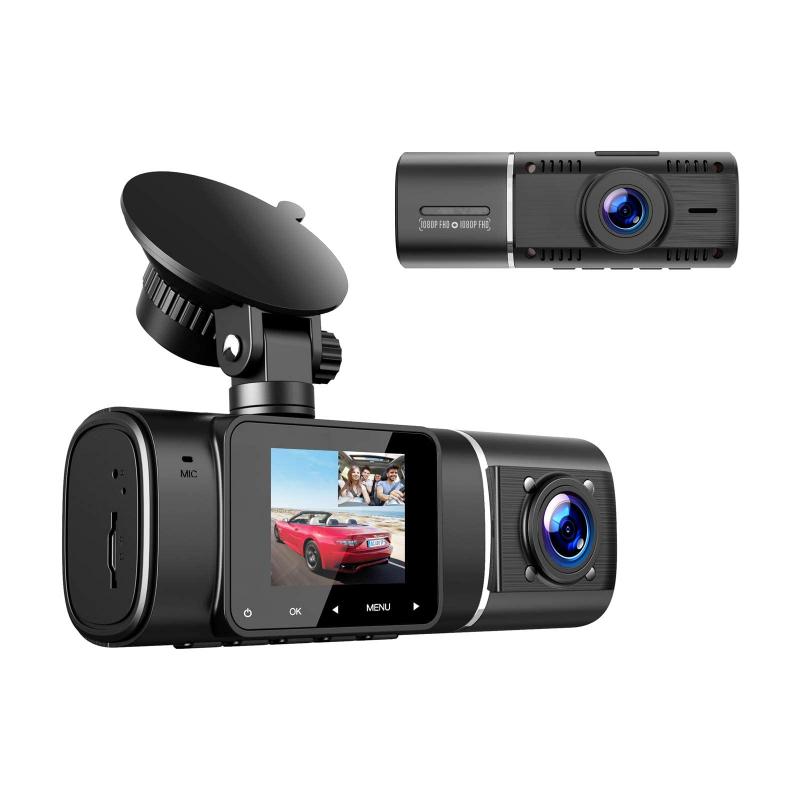
- GPS lock speed: Look for a dash cam that locks onto GPS quickly after startup and keeps a stable signal. If GPS drops often, your speed data may be incomplete.
- Timestamp and location data: Speed alone is less useful without time and place. A strong timeline usually includes all three: video + timestamp + location.
- Built-in vs. external GPS: A built-in GPS means you won't have to deal with as many wires on your windshield. You can put an external GPS anywhere in your car to get the best signal.
- Video resolution: It's just as important to have a clear video as it is to have accurate speed data. Choose a camera that can record in 2K or 4K quality. For smooth video, especially when driving fast, a high frame rate is also important.
- Night readability: Night footage matters. What matters is whether the footage stays readable — especially street signs, lighting changes, and the overall scene.
- Memory and loop recording: For your camera to save video and speed data, it needs a good memory card. When the card is full, it will write over old files. Buy a strong memory card made for dash cams so you won't lose important proof.
- Easy export of original files: If your priority is preserving evidence quality, make sure your dash cam allows easy export of the original file with its data intact. Cropping or editing can remove context or reduce clarity.
You can verify that speed logging works in a few minutes: enable GPS, wait for GPS lock, take a short test drive, then review a clip for overlay or check the app for speed and location data. Export the original file and confirm the timestamp and location details remain intact. If the camera never locks GPS, try moving to a clearer area or checking the GPS settings and placement.
Legal Considerations for Dash Cam Speed in the US
Some drivers are unsure about laws for dash cams in their cars, especially about dash cams that record speed features. In most states, these cameras are allowed.
- You can legally put a dash cam in your car in every state. However, some states have specific rules about where on your windshield you can place it. The most important rule is that you must not block your view of the road. Always check your local laws.
- Police and insurance companies often use your dash cam videos as evidence. But they might question how accurate your speed data is. Your footage can support your case, but it may not be the only proof in a serious court situation.
- You should know about audio privacy laws if you record conversations with passengers. In some states, you must tell your passengers they are being recorded.
- Dash cam footage can help support a timeline, but it doesn't guarantee a specific result in court or with law enforcement.
- Insurance companies may accept video files with velocity stamps. When you are wrongly accused of fault, this data strongly backs up your case.