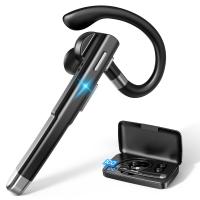
How Does A Wireless Headphones Work?
How Bluetooth Technology Receives Audio Signals
At its simplest, wireless headphones use Bluetooth technology to receive audio signals from a source like your smartphone, laptop, or TV.
In a nutshell, wireless headphones work by receiving a transmitted signal from a paired source of audio - usually your phone or laptop.
Your phone (or other audio source) will encode signals, then transmit those signals via radio frequencies (although some headphones use infrared), which your headphones will pick up and decode again into the audio you listen to.
Bluetooth is the most commonly used wireless technology, and this also operates on short-wave radio frequencies.
Bluetooth is a radio frequency wireless packet data transfer protocol.
It’s a wireless technology standard that uses radio waves to pass data over short distances, effectively sharing files between devices.
This makes it possible to send music or podcasts from your phone to your earbuds without physically connecting the two devices.
Instead of sound travelling through a copper wire, it’s sent as a digital signal.
- Bluetooth is the most commonly used wireless technology.
- Bluetooth is a radio frequency wireless packet data transfer protocol.
- It’s a wireless technology standard that uses radio waves to pass data over short distances.
- Wireless headphones use Bluetooth technology to receive audio signals from a source like your smartphone, laptop, or TV.
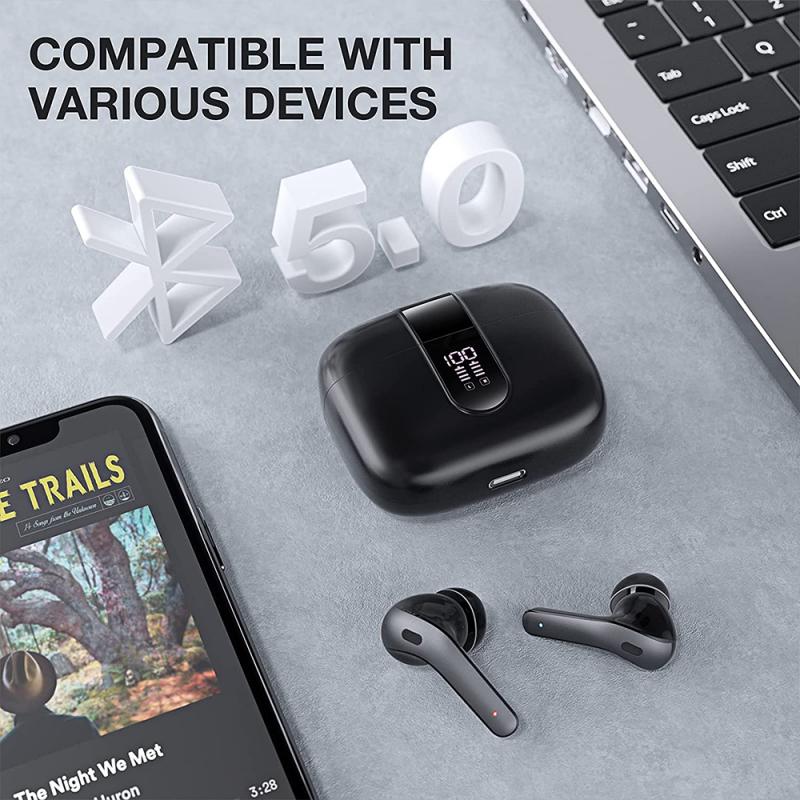
Radio Frequencies and Bluetooth Range
All Bluetooth operates on a band between 2.400 to 2.485 GHz, which means there are almost 80 different frequencies over which a source can transmit signals to a Bluetooth receiving device - that’s how you can have numerous Bluetooth connections (or headsets) running in the same home without them interfering with each other.
Bluetooth range is around 30 feet, and if you move too far away from the source device, your audio will begin to cut out, as the radio waves aren’t able to reach your headphones.
However, as long as you stay close enough to the audio source, Bluetooth provides a consistent and reliable connection, even while running or moving through busy areas.
This gives you the freedom to move around your home or office within a range of about ten metres without being tethered to your device.
Radio waves are like a color of light; this color shines very very red - so red we can’t see the light.
In addition, in the way that glass is transparent to visual light, many materials are pretty transparent to radio waves.
It’s a little strange to imagine, but the “lightbulb” and the “camera” are wires, antennas, that are sensitive to each others’ color (the “color” of the 2.4GHz electromagnetic frequency, give or take a little bit of color shifting to either side).
- Bluetooth operates on a band between 2.400 to 2.485 GHz.
- There are almost 80 different frequencies over which a source can transmit signals to a Bluetooth receiving device.
- Bluetooth range is around 30 feet.
- Wireless headphones give you the freedom to move around your home or office within a range of about ten metres.
Pairing and Communication
However, you must first pair the source and headphones together, which creates a connection, allowing them to communicate.
Because Bluetooth is a universal standard, there are set requirements electronics must meet to use the technology, ensuring they always work properly with other Bluetooth devices.
This frequency is used by lots of things - microwaves send out this “color”, lots of short-range radios like garage door openers, some of the WiFi bands, etc.
So the first thing Bluetooth devices do to pair is they go through a protocol.
Think something like Morse code, where the host (like your phone) sends a code, “anyone there?” and your headphones blink back, “I’m here”.
A call and response sort of thing.
“Are you blinking like a Bluetooth device, or do you just look like random microwave noise”.
They then trade more messages back and forth, e.g. “I think we’ll see less interference on a slightly different color”, “ok”! “What are you capable of”, “I’m a 2-way streaming audio device”, etc.
- Fully charged, turned on and compatible with the smartphone you want to pair.
- Turn on the phone. Look for the Bluetooth feature, usually found under settings.
- Select on (when you turn on the Bluetooth feature, the phone sends out a signal and starts scanning for other Bluetooth-enabled devices, such as your headset).
- When the phone finds the headset, the headset will show up on the list of devices.
- Once the devices are paired, all your phone calls will connect automatically to your headset as long as it’s turned on, and you won’t have to repeat the pairing process.
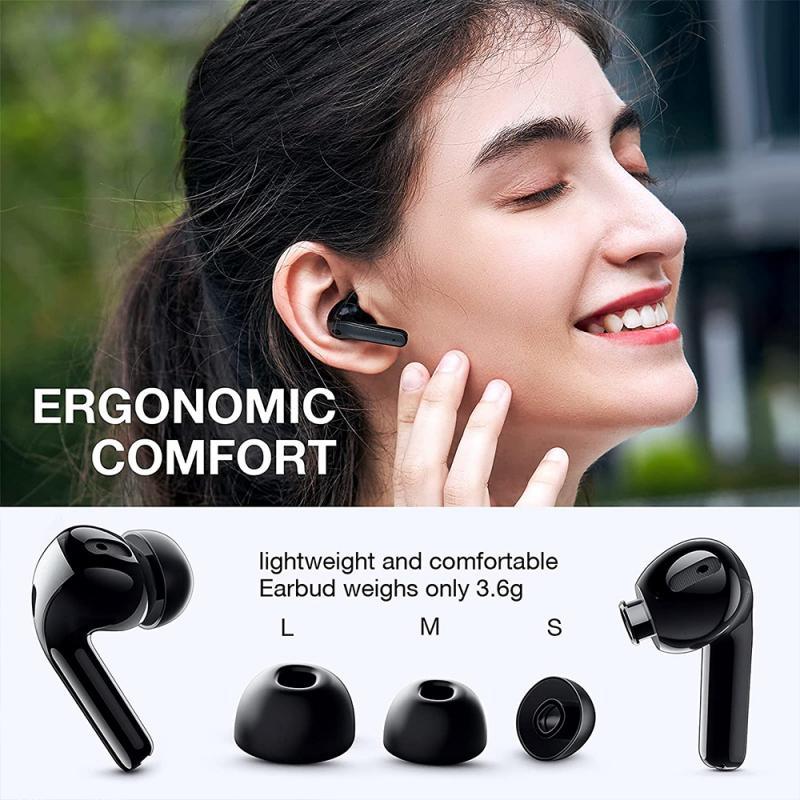
Audio Data and Control Signals
During this, once the basic communication is established the devices soon start sending packets.
These packets (and basically packets in the internet, and most packet based protocols) have metadata sequences around the actual data - this is a “header” that says which device is transmitting, what channel it’s using (because it could be sending multiple “streams” of data in near-paralell), and a checksum - basically a value that says “if you got this, you can do some math and the answer you should get is 12345” so that the receiver can be confident that they got it all correctly.
These packets use an agreed-upon-beforehand structure, e.g. “the device’s id is the first 12 blinks”, “the channel identifier is 20 blinks”, “the rest of the data is 2048 blinks”.
This all serves to act like an envelope to a small piece of mail.
It’s there to make sure that whatever’s inside is safe and going to the right place and interpreted correctly.
After that, the devices can basically send whatever they want since they’re talking the same protocol.
- Audio modification
- They can send a “audio modification” envelope with the contents “volume up one notch”.
- Media position change
- They can send a “media position change” envelope with “skip forward one chunk of time”.
- Audio data
- The rest of the time your phone can send a “here’s the next 1/2 second of audio data” envelope with the actual sound data as its contents.
If the envelopes contain a bunch of audio data, that can be stitched back together chunk by chunk into the actual audio; or they can send other control signals to ensure they are communicating what you want to each other.
Wireless Headphone Types
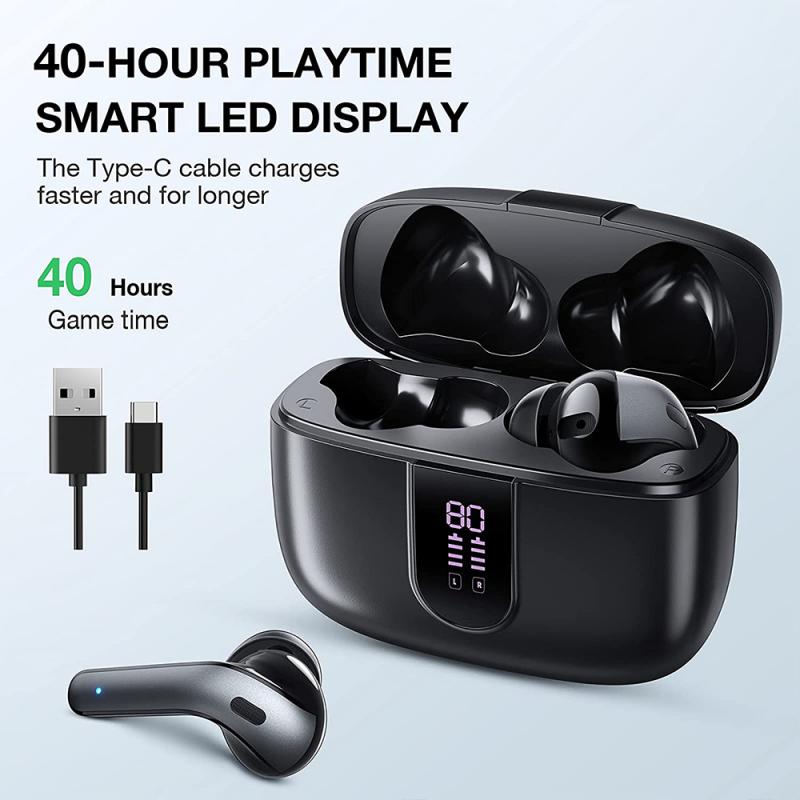
There are three types of wireless Bluetooth headphones. On-ear and over-ear wireless Bluetooth headphones and (in-ear) wireless earbuds.
In addition, all variants are also available as special sport headphones.
On-ear headphones and over-ear headphones often get confused, as they do look reasonably similar.
Both are the traditional style of large headphones that have ear pads that sit on or over your ears.
However, on-ear wireless headphones have ear pads that sit directly against your ears.
They have quite small ear cups, which means the set itself is usually smaller, more compact, and easy to carry or travel with.
On the other hand, over-ear wireless headphones also have their own benefits.
Some people may find that when the cups sit over your ears, rather than directly against them as with on-ear headphones, that over-ear headphones are therefore more comfortable for long periods of wear.
- On-ear and over-ear wireless Bluetooth headphones.
- (In-ear) wireless earbuds.
- Wireless earbuds are the kind that sit in your ear.
- They are very small and lightweight, making them easy to use on the move, and take with you everywhere you go.
- Wireless earbuds are still connected between the two buds, usually with a small wire that loops around the back of your head.
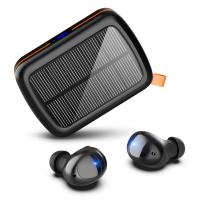
- True wireless earbuds are super compact, without a wire connecting between each earbud.